

As the class of 2026 approaches graduation, many students are entering a job market that is becoming more difficult to break into.
Jobs are still available and wages have remained relatively stable, but hiring has slowed, and competition has increased.
For new graduates, that means sending out more applications, waiting longer for responses and facing more uncertainty about when, or if, they will secure a full-time position.
“It’s not great,” said Evan J. Taylor, an associate professor of economics at the University of Arizona. “It’s definitely weaker this year than it’s been, probably the weakest it’s been since COVID.”
The shift is not defined by layoffs, but by hesitation. According to Business Insider, employers are hiring more cautiously, posting fewer entry-level roles and taking longer to make decisions. As a result, graduates are facing a slower and more competitive transition from the classroom to the 9-to-5 work world.
“We’re not seeing a lot of layoffs, but we’re not really seeing a lot of hires either,” Taylor said. “For people entering the job market, it’s kind of hard to find a job right now.”
The numbers reflect that slowdown. The unemployment rate for college graduates ages 22 to 27 has risen to about 5.6%, the highest level since 2021, according to Taylor. At the same time, competition has intensified. Job postings for early-career roles have declined, while the number of applications per position has surged, making it increasingly difficult for graduates to stand out.
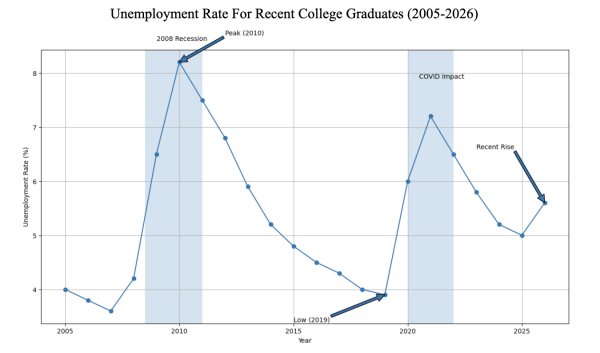
According to data from the Federal Reserve Bank of New York, the overall unemployment rate for recent college graduates is about 4.2%, but underemployment, defined as working in jobs that do not require a degree, is nearly 40%. That gap highlights a growing issue for new graduates – not just finding a job, but finding one that actually uses their education.
For many students, that reality has reshaped how they approach the job search.
Jack Horn, a UA communications major graduating this spring, said he has had to broaden his expectations while applying for roles in finance.
“I’m hoping to get a job at Charles Schwab after I finish my licensing exam, but it’s definitely competitive,” Horn said. “I’ve seen many people including my own friends get hired at Vanguard who didn’t even major in business. It feels like it’s more about how you position yourself than what your degree is.”
That shift reflects a broader change in how employers evaluate candidates. A degree alone is no longer a guarantee of employment. Increasingly, hiring decisions are based on skills, experience and the ability to demonstrate value beyond coursework. Read more
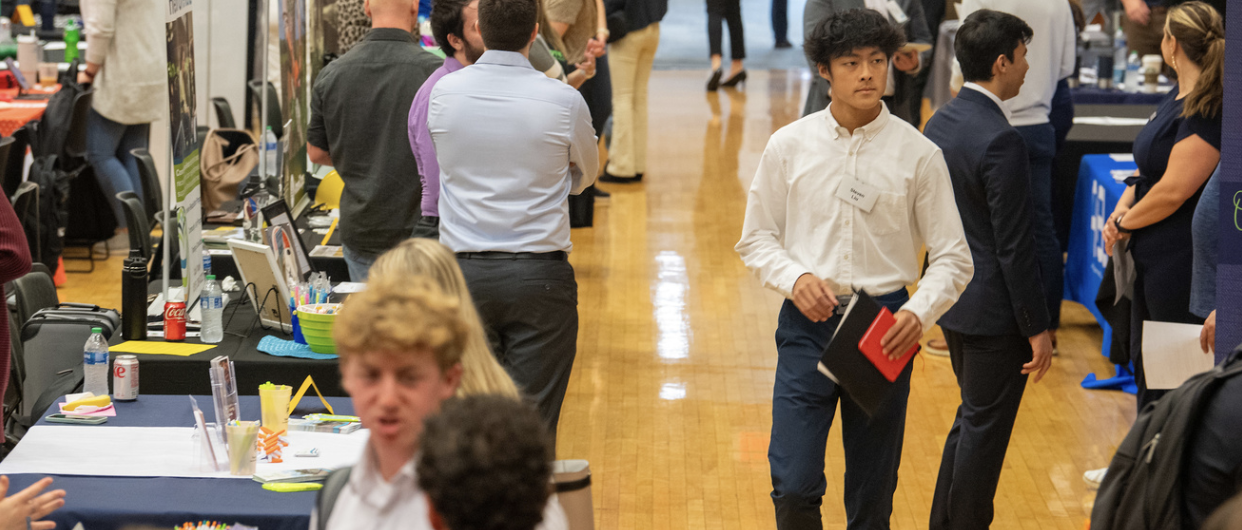
“Experience is important,” Taylor said. “If you can do internships or build skills, that’s going to be valuable. The skills you build are going to be more important than your degree.”
Even so, the value of a degree still varies widely depending on the field of study. Data from the Federal Reserve Bank of New York shows that graduates in fields such as nursing and engineering continue to see strong employment outcomes, with low unemployment rates and a higher likelihood of working in their field.
“If you’re in engineering or healthcare, you should feel pretty optimistic,” Taylor said. “If you’re in the liberal arts or fine arts, those tend to have higher unemployment and lower wages.”
For some students, success in this environment depends on anticipating those realities early.
Maguire Peterson, a UA business management senior graduating in May, recently landed a position as a financial services representative at Fidelity Investments.
“I started applying early and focused on building experience I could actually talk about,” Peterson said. “I wasn’t just relying on my degree. I tried to make sure I had something that made me stand out. My internships have definitely helped that.”
Students like Peterson are increasingly treating the job search as a strategic process rather than a final step. Many are applying to more positions, tailoring resumes to specific roles, and expanding their search beyond well-known companies. Others are pursuing certifications or technical skills to strengthen their applications.
Even for those who do find jobs, the transition is often not immediate. Many graduates leave college without landing a job, entering a period where they are actively searching while earning little to no income.
Surveys from the National Association of Colleges and Employers show that a significant share of students do not have a ful-time job lined up at graduation, and it can take several months to find one. During that time, many rely on part-time work, internships or financial support while continuing their search.
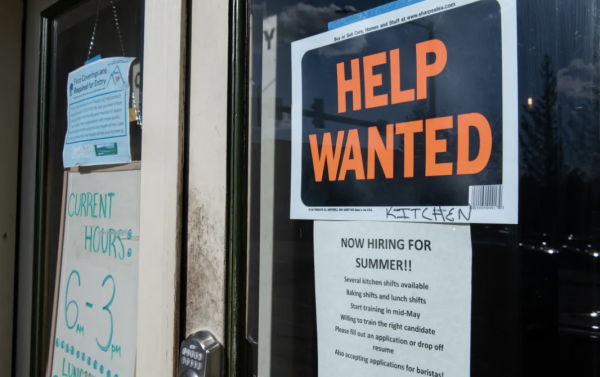
A “Help Wanted” sign is displayed at a local Tucson business.
Those who do get hired can fetch an average salary of $60,000, according to NACE.
But uncertainty remains a defining feature of the current job market. More than half of employers describe entry-level hiring conditions as only fair or poor, and a majority of students report feeling pessimistic about their job prospects.
The outlook is not uniformly negative. Wages for recent graduates have largely kept pace with inflation, suggesting that the challenge is not the quality of jobs, but access to them, Taylor said.
Arizona Sonoran News is a news service of the University of Arizona School of Journalism.