

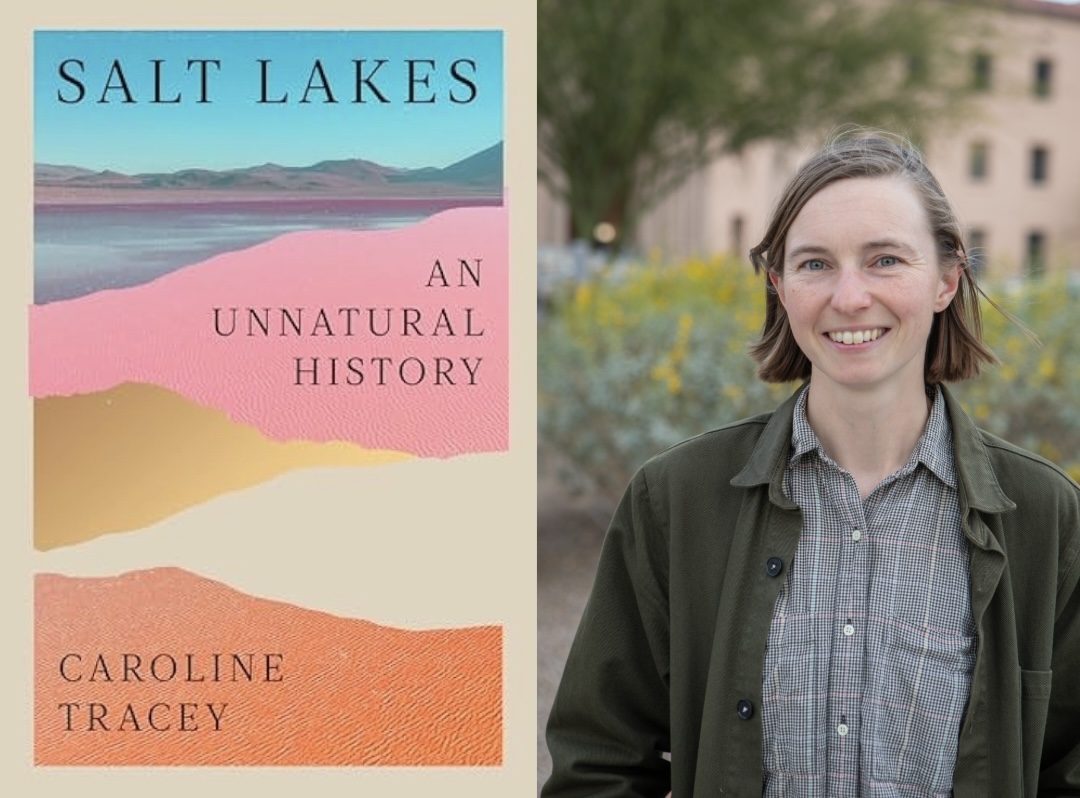
There are salt lakes around the world: The Great Salt Lake in Utah. The Aral Sea in Kazakhstan. The Salton Sea and Mono Lake in California. In her new book “Salt Lakes,” journalist, author and critic Caroline Tracy takes readers to each in a story that explores these unique ecosystems and her own identity.
The water in salt lakes comes from freshwater rivers, but throughout history, these rivers have been diverted for human use – irrigation, canals, industry. As these lakes receive less water, they dry up, killing the organisms living there and revealing harmful minerals that can be picked up by the wind and lead to harmful levels of air pollution.
Tracy, who has a PhD in geography from the University of California, Berkeley, shares a collection of her writings about her visits to these salt lakes, the people she has met and her personal journeys.
In “Salt Lakes” Tracy takes a piece of her own life to look at salt lakes through a new, queer perspective. She investigates the lakes using queer ecology, a framework that explores the different non-heteronormative relationships in nature, like those in salt lakes.
Tracy will have a book launch for “Salt Lakes” at 5 p.m. Friday, March 28, at Antigone Books, 411 N. Fourth Ave.
The following conversation has been edited for length and clarity.
Question: What made you realize you wanted to write this book? In the book you mention how salt and salt lakes were following you, when did you realize this and what they meant to you?
Caroline Tracy: I started wanting to write a book, kind of forever ago, I always wanted to be a writer. This particular book I didn’t know was going to take the form that it did until almost halfway through the process.
I started noticing Salt Lakes when I was in my early 20s when I was on road trips around California and Nevada. And I got really interested in what they were, why they existed and why they were kind of such strange features in the landscape. But at the time, I was really interested in writing personal essays, very inspired by writers like Joan Didion. And at the time, Roxanne Gay was a really big writer in 2014 that had just come out with a really big book. So that was the type of thing I was interested in writing, and over time, I just realized that environmental reportage and scientific research was really interesting to me.
So I gradually started to kind of shape the book more around Salt Lakes, because I had realized they were a theme, and I’d thought then, you could have a pathway through a collection of essays that’s following the Salt Lakes. But then I realized, what if it was just a whole book about the salt lakes? And that was a really important turning point because it made it into not necessarily a book of personal essays, even though I think the result is somewhat essayistic and personalistic, but also a book that was kind of about this thing (salt lakes).
Q: Going off of that, what was the most memorable or important experience you had that really solidified your passion for the salt lakes
A: On some level, I’m like, they’re all super memorable. Part of me is like, I didn’t spend nearly enough time at salt lakes, but then when I look back, I spent tons of really important times of my life at salt lakes.
The visit to the Salton Sea that I describe in chapter two was really formative because that kind of kicked off my whole interest. But then I describe a little later in the book, I took this really long train journey to the Aral Sea in Central Asia, and I think that was when I felt really kind of committed to the topic because I went on this journey that was challenging to plan and expensive. And so I was like, okay, I guess I’m really into this topic now. Then when I got back, I tried to write an essay about it, but I was just so engrossed by the research that I just had thousands and thousands of words about the history of the Aral Sea, that it didn’t take a readable form until the final version you read in the book. It never got published as a standalone, I think, because it was just too long.
Q: How did you feel writing this book?
A: I feel like the book was such a part of my life and almost my daily life for a really long time because I was just always working on it, so it kind of accompanied me through a lot of different times in my life. I don’t think I felt any one specific way while I was writing it just because it did take such a long time, but I would say that the project became almost like my companion. It was something that was steady and I think it’s one of the nice things about being a writer, you always have a purpose in your life. Maybe not if you don’t have a project. But when you have a project, you feel a sense of purpose. And I guess maybe that’s the thing that’s nice about it
Q: How did you want your book to make readers feel?
A: People have asked me if I want people to become obsessed with salt lakes, which, I guess, I certainly would love for lawmakers in Utah to read it and pass certain legislation related to the Great Salt Lake. And not only Utah but all the different states that have these ecosystems.
For more ordinary readers, I don’t necessarily want them to feel like they need to become obsessed with salt lakes specifically or feel like they need to go visit a salt lake. I would say maybe one thing it can do is show people that there are all kinds of unusual ecosystems and aspects of the natural world that you can become really interested in and that may be threatened in ways that people aren’t paying attention to but are still important. I think that my goal is that people can kind of find their own salt lakes. It doesn’t have to be something in nature, but find something that they find really fruitful in terms of, like an obsession or something that speaks to their life in a certain way.
Q: How did you feel learning about how the Paiute and other Indigenous tribes understood the hydrology of the lakes? Did it reaffirm your connection to them?
A: Yeah, I think that it’s sort of like one of the things that a lot of writers, scholars and activists are thinking about right now. There are a lot of conversations going on about the fact that there is a lot of Indigenous knowledge that we’re often taught was kind of lost or erased. And actually, there is a lot of Indigenous knowledge that has been passed down to the present day, whether or not those of us who are not Indigenous know about it. So, for me, it felt like it was important to ensure that I was able to speak with some people who could talk with me about the role that Salt lakes played in those cultures. Because a lot of the book is about the destruction of salt lakes by settlers, with irrigation diversions and other types of policies. So it was useful for me to learn that there is a way to kind of steward these lakes over time and hold them as an important place culturally. It was also a really interesting pattern to me that many different cultures had really valued these salt lakes and found them to be striking and interesting and even sacred. And so it made me feel like there was a reason that they were so alluring to me.
Q: How has the intersection of religion and the salt lakes you faced affected you and your views?
A: When I was researching the book, I started to wonder a lot about Great Salt Lake because it’s been in the news a lot with its water level declining and what role the Mormon or LDS Church might play in saving it or harming it. I just had a question of ‘What’s the role of that church?’ Because it’s a very big entity and it’s headquartered in Salt Lake, obviously. So I think it was really rewarding to speak to scholars from within the church who are thinking about how their traditions, scripture and history seek environmentalism. I definitely got the sense from those interviews that those people who are really kind of outspoken environmentalists within the Mormon church feel like they’re a pretty small minority, but that they are pretty optimistic that their ranks will grow.
So, I think that one thing that I took away from those interviews in particular was that there is sort of this American religious tradition that involves valuing a salt lake. Not only an Indigenous tradition, but also sort of more recent, modern settler religions have incorporated the Great Salt Lake into its thoughts. That was interesting for me to learn, and also, I think the outlook that a lot of those people that I interviewed had was very, very much one of optimism. And so that was beneficial for me because when you’re an environmental reporter, it can be a lot of pessimism.
Q: Can you explain the premise of queer ecology?
A: Queer ecology is not necessarily one specific thing, but a body of theory that has been developed by scholars from queer and cultural studies and other disciplines. There are three main aspects of it. One of them is queerness in nature from a species and reproduction perspective. There are some biologists that have written about how a lot of creatures in nature don’t conform to the male and female sexual reproduction that we’re kind of taught about in like ninth-grade bio. So they’ve tried to revindicate nature and show that there are all types of different ways that families can be made and reproduction can happen.
Another aspect of queer ecology is as a perspective on landscapes. Appreciating landscapes that are outside the norm or have been impacted by humans in unusual ways and seeing that they can also sort of thrive as landscapes or ecosystems, just as a different type than ordinary conservation science or landscape ecology sort of values.
The third one is queer ecology as a perspective on doing science. There’s an ecologist named Cleo Wolfley Hazard that I cite in the book who talks about how, for instance, there are traditions of kind of queer practices of mourning that have been developed over time, especially with the AIDS crisis in the ’80s. And that can be applied to scientists doing work on climate change that also have to mourn things that are being lost.
Q: You mentioned alcoholism and certain injuries, where recovery is a lifelong challenge and that sometimes full recovery is impossible and changes you. Do you think that recovering the salt lakes is possible?
A: I thought the AA vision of recovery was really interesting. And I mean, I’m not an alcoholic, I don’t have a personal experience with it, but I did find it really interesting to read about because when you sort of have a simplistic idea of recovery, kind of like, ‘Oh they had this disease and then they made a full recovery and they’re just back to normal.” But actually, maybe it’s more of a process and something that doesn’t ever bring you back to the exact starting point and changes you.
So, with the salt lakes, I think that recovery is complicated in that way. In the case of the Aral Sea, it really is somewhat unlikely that it will be able to come back because it was such a huge lake. That it would require an enormous amount of water and a lot of it has already been lost. So I think the recovery there has been kind of recreating a small portion of the lake, because that’s really meaningful for the people that live there. Not only economically but culturally and as a part of their way of life. Where as somewhere like Owens Lake, which is a dry lake in Eastern California, it’s a similar case, where it got basically completely dried and it has also had a degree of recovery because the Los Angeles Department of Water and Power has had to control the dust there. But they haven’t done it by flooding the lake bed again. It’s been by doing a variety of different types of dust mitigation efforts. But it has been a recovery because it has recovered a lot of the ecosystem elements of lakes, birds and brine shrimp have come back. So I think it counts as a recovery and people and scientists are really thrilled by elements of what has happened, even though it’s a totally different ecosystem to what existed before.
Arizona Sonoran News is a news service of the University of Arizona School of Journalism.