


Even longtime Arizona residents well-adapted to hotter conditions may now face increasing threats from extreme heat as the climate changes. But those impacts are often compounded for women and gender-diverse people.
Extreme heat disproportionately affects marginalized communities, and climate disasters expose and deepen inequality, according to a report by the Center for Biological Diversity, which is looking at connections between gender and climate and using mutual aid to help people during crises.
“I’m an health educator, so for me, talking about sexual health comes pretty natural, but I don’t think it necessarily comes natural for others,” said Kelly Dennings, senior campaigner for the Center for Biological Diversity.
Her team organizes pop-up events, reports and campaigns through their Sexual Health Emergency Preparedness project that highlights accessibility to sexual and reproductive health supplies like menstrual products and birth control during climate emergencies.
“I think approaching the subject more around emergency preparedness and making sure that these things are in your go-bag along with everything else was a good way for us to communicate it,” she said.
Projects like this are among the ways environmental and public health professionals are trying to address the social impacts of heat.
Heat in Southern Arizona
Southern Arizona experienced record-breaking early heat this March, with temperatures reaching 100 degrees, according to the National Weather Service, which issued extreme heat warnings in Tucson.

The line graph shows that recorded temperatures in Tucson were significantly higher this March than historical averages from 1991 to 2020. The vertical axis shows temperature in degrees Fahrenheit, while the horizontal axis displays the dates in March.
“How do people move forward when we have this whole new landscape we’re having to navigate,” said Mark Kear, associate professor at the University of Arizona School of Geography, Development and the Environment. “The extreme high temperatures are going up, the nighttime lows are going up, and the length of the period where we have to worry about those extremes is getting wider.”
Laws and policies are not set up to protect people from 100-degree days this early in the year, he said. These forecasts prompted the National Weather Service and other organizations to send out heat safety resources to help the community prepare for the impacts of unprecedented heat exposure.
People who study extreme heat have been advocating for major heat waves to be treated like other natural disasters, Kear said.
“There’s a sense in which the impacts of heat are kind of invisible, even though we know that they’re actually quite profound,” he said.
Because heat is not considered a climate disaster, states like Arizona get far fewer dollars per eligible household than places that are in colder climates. That means many of the state’s assistance programs are not as well-suited to deal with extreme heat, he said.
There is an imbalance between the size of the impacts and the systems available to respond to those impacts, he said. That hampers the ability to mobilize massive amounts of public resources to address the impacts of heat.
While many think of climate disasters as physical phenomena, heat researchers like Kear are trying to emphasize the ways in which heat is also a social issue.
“There are some really interesting, but also very understudied and problematic ways in which gender hierarchies in our society affect the way in which people are exposed, experience and adapt to extreme heat,” he said.
Each person’s experience of heat is mediated through their environment and access to resources, he said.
“It’s mediated by our access to networks that can help support us. It’s mediated by our access to resources. It’s mediated by the types of structures we live in, where we work, access to vehicles,” he said.
Gendered impacts of heat
Heat-related disasters have major impacts on communities, and gender plays a significant role in who is most at risk, experts say.
Climate disasters make support like healthcare hard to access, especially for sexual and reproductive health services and can cause pregnancy complications, according to the Center for Biological Diversity.
Extreme heat exposure has also been linked to preterm labor, stillborn births, low birth weight, infant mortality and developmental delays.
“A good bit of literature shows that women and gender diverse people struggle to bounce back and have less resiliency after a disaster, and a lot of times it’s because they’re main caregivers,” Dennings said.
She and her team are examining how gender and reproductive health are represented in climate planning and emergency preparedness.
“If you don’t have a pregnant person at the table when planning these items, or a woman or gender diverse person, you’re not going to get their viewpoints in the plan or the checklist or whatever it may be,” she said.
Dennings and her team are working to get more sexual and reproductive health supplies into state emergency preparedness checklists administered by sources like state departments and nonprofit organizations to ensure that stakeholders add these things to climate-related policies and action plans.
They are also trying to impact public opinion, she said.
Sexual and reproductive preparedness
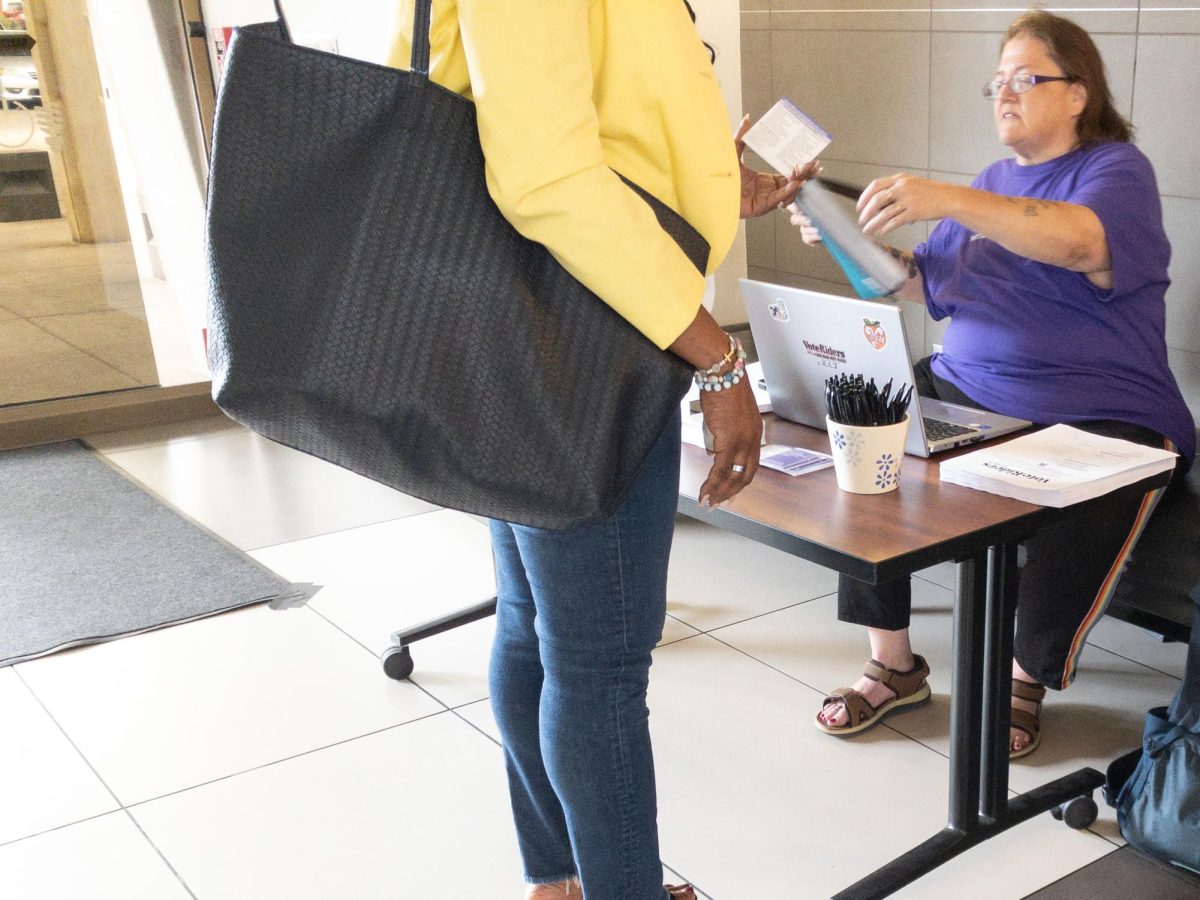
In March, the Center for Biological Diversity partnered with the UA Women & Gender Student Space and the College of Public Health Southwest Center on Resilience for Climate Change and Health to give out sexual and reproductive health emergency preparedness kits on the UA Mall.
Kits included condoms, emergency contraception, period products, pregnancy tests, lubricant and a small brochure about extreme weather disaster readiness and relief related to gender justice. People may think to grab water bottles and flashlights during an emergency, but they may forget to grab these kinds of items when in a crisis, Dennings said.

Kelly Dennings, Joyce Hospodar and Malia Becker (left to right) pose behind their table with free reproductive and sexual health emergency response kits at the University of Arizona Mall on March 6, 2026.
This pop-up event was piloted by Dennings and her team in the Center for Biological Diversity’s Population and Sustainability program, which looks at the ways human consumption impacts the environment. Their campaigns often make connections at the intersection of environmental and human health.
She started distributing the kits in her hometown in Jacksonville, Fla., in 2024 and has expanded into other areas. This was their first distribution at a university campus.
“We really wanted to not only provide the resources and to build connections with our local and state partners, but also build coalitions and support groups for community resilience related to mutual aid,” Dennings said.
Climate disasters and extreme weather impact everyone’s health. But historical racism and urban planning mean marginalized communities are disproportionately affected, said Malia Becker.
“Our partners on the ground in Tucson have now had several conversations at this intersection of health and climate,” said Becker, an organizer for the Population and Sustainability program’s creative outreach campaigns, which look at the reciprocal relationships between reproductive health, gender equity and consumption on wildlife and biodiversity.
College campuses play a crucial role in bringing people from environmental and public health fields together and raising consciousness around the intersections of climate and reproductive health, she added.
“The number of conversations that have come out of even our presence for a couple hours on the U of A campus has been really amazing,” she said.
The Mel and Enid Zuckerman College of Public Health and Campus Health are partnering with the Center for Biological Diversity for another sexual health preparedness kit distribution event for Earth Day on Wednesday, April 22, at Drachman Hall Walkway of Wellness at 1295 N. Martin Ave.
“We’d really love to see other campuses or other organizations take this up and host their own events,” Beckner said.
Arizona Sonoran News is a news service of the University of Arizona School of Journalism.