

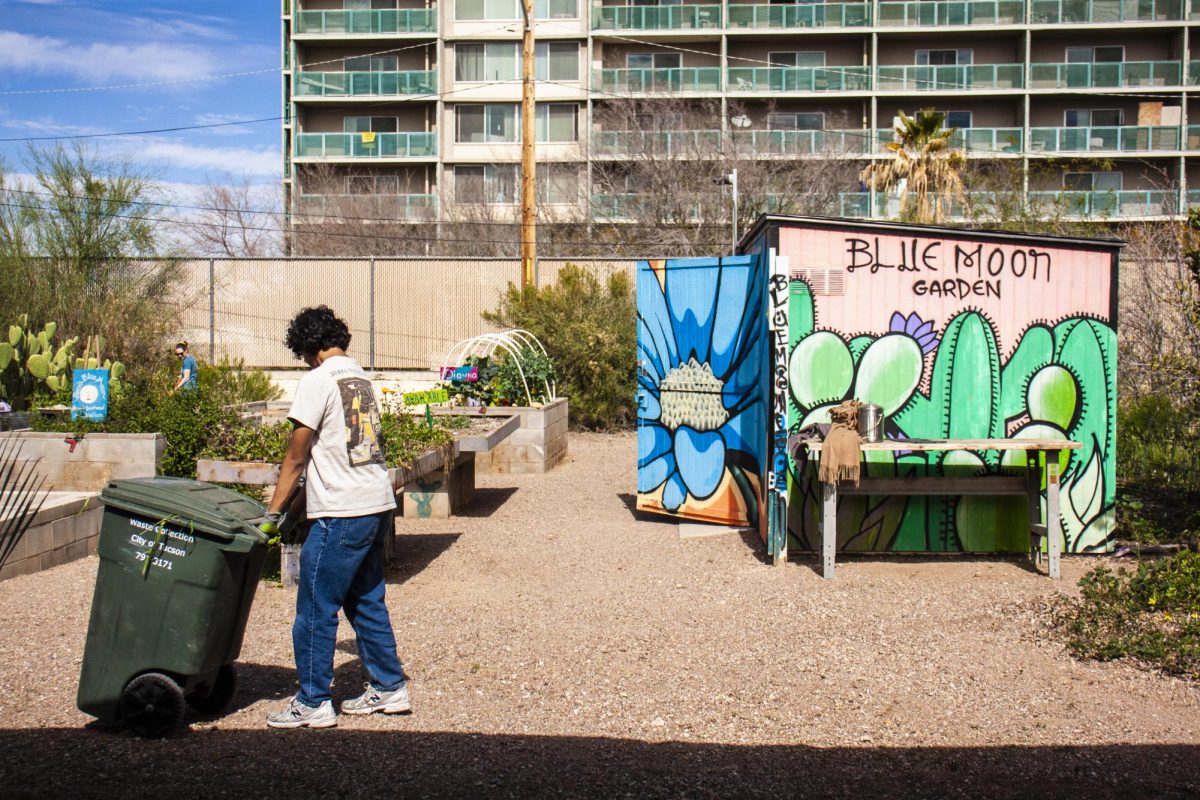
On a recent Sunday, Jen Thorn gathered with a small group of people around picnic tables under the shade of Blue Moon Garden’s ramada, surrounded by garden plots filled with lush green plants. After a quick icebreaker activity and a few introductions, Thorn held up an infographic to start her presentation.
“It’s the Arizona Food Systems Network’s picture of our food system here,” she said. “I just want to point out what the various areas of the food system are, so that as we’re thinking about it, we’re thinking about it more holistically.”
She points to a whiteboard illustrating the food system’s circular network and briefly describes each part, starting with food production, then processing, distribution, marketing, preparation, consumption and waste management.
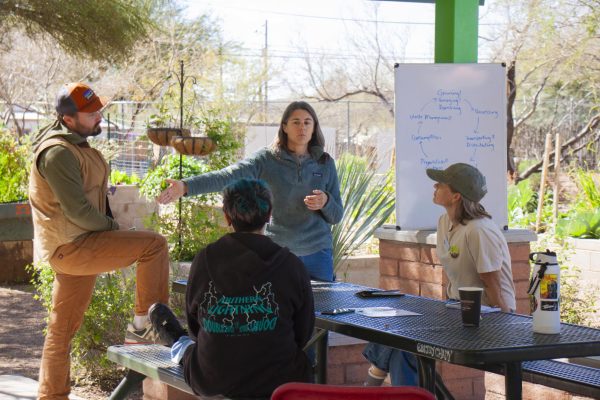
The discussion was part of a Food Systems 101 event organized by Pima County Food Alliance (PCFA), a food policy council that aims to educate and connect with people in the food system network through policy, advocacy, community building and outreach.
The coalition was established in 2011 through a collaboration between staff at the University of Arizona’s College of Public Health and the Community Food Bank of Southern Arizona.
PCFA includes local community members, farmers, market managers, researchers, university students and agency staff who work with other cross-sectoral partners. The group has expanded over the years to create diverse community resources and working groups.
What is a food system?
One of the ways PCFA brings its mission to life is through accessible educational opportunities, like the Food Systems 101 event.
As Thorn gave her presentation, Gillian Paine-Murrieta, a Community Gardens of Tucson board chair, separated leaves and stems of New Zealand spinach she picked from her home garden and offered them to other participants.
“We realized no one really knew about food systems,” said Lou Haiduk, garden education coordinator for Community Gardens of Tucson. She collaborated with Thorn, PCFA’s safe and healthy foods working group chair, to organize the event last Sunday morning at Blue Moon Garden.
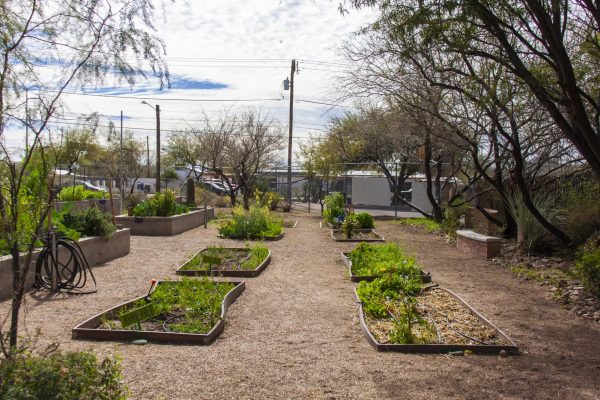
Blue Moon is one of the group’s largest community gardens, spanning half an acre directly south of Tucson House apartments in the Barrio Blue Moon neighborhood.
During her presentation, Thorn asked the group to consider how food systems provide for everyone in the community, including food equity, cultural availability, transportation, affordability, efficiency, resiliency, safety, environmental costs and individuals’ roles.
“As you think about being involved in food systems, it’s kind of a balance of how do we maximize the benefits of a healthy food system and minimize the downsides?” she said.
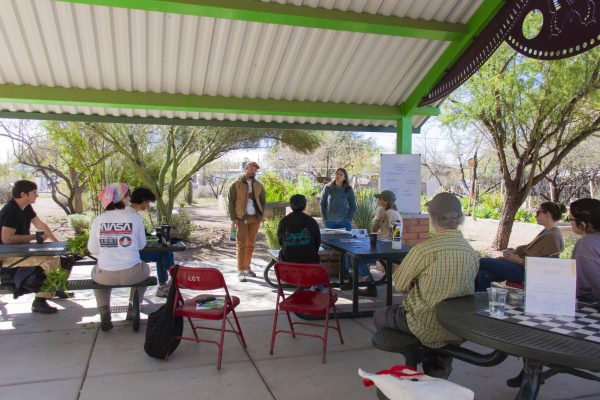
Randy Davidson, Community Food Bank of Arizona’s Las Milpitas Farm education coordinator, shared examples with the group from the Community Food Bank’s local food systems work at Las Milpitas.
“I feel like the emphasis really is within the community,” he said.
Las Milpitas, a six-acre community farm on the western banks of the Santa Cruz River, acts as a community space with trainings and access to resources like composting, gardening, and gatherings around sharing and cooking food, he said.
“In our society system, a lot of it is based off of buying at the supermarket, going to big retail stores to buy your food, and it misses a lot of those steps that people don’t get to observe or see,” he said. “I think when you’re a part of that process, you get to see how that system works and how it plays all together.”
Part of PCFA’s food system work emphasizes culturally relevant foods. At Las Milpitas, people who have faced challenges with land privatization and land ownership have the opportunity to rent commercial plots and sell their crops at local markets.
That benefits not only the community through fostering support of local growers but also the environment by prioritizing seasonal and native crops that contribute to the health of the region’s ecosystem, Davidson said. It also limits food waste by minimizing processing and transportation needed for food and products sourced from other states or countries.
“I think that’s a part of the food system, really, that is important to highlight,” he said. “People don’t talk about it, so then it gets forgotten.”
After the presentations, Thorn invited participants to form small groups to identify their individual roles in the food system and brainstorm ways to get more involved.
Brittany Guerrero, executive director of Community Gardens of Tucson, said her experience moving to Tucson from the Northwest made implementing sustainable practices challenging. After finding a supportive community through Community Gardens and PCFA, those values around food sustainability were reinforced for her.
Guerrero said when you start gardening, it cultivates a full appreciation of all the things that go into growing, like work, water, sun, soil and space.
“Then that translates to, I know that the farmers that are making the food that I’m buying are working even harder to get that to me,” she said. “So I think it really does shift your thinking, doing it yourself.”
Cultivating change one step at a time
The importance of local food systems and community involvement is at the core of PCFA’s work. The group emphasizes supporting local farmers and the value of growing one’s own food, the benefits of community sharing, the historical impact of industrialization on local food systems and the need for advocacy to improve local food infrastructure.
The group offers various resources for people to get involved with specific areas in the local food system.
They work to expand sustainable food access by supporting local food availability, reducing distribution barriers and collaborating with other community organizations. They highlight education and outreach through policy and advocacy to build more equitable and sustainable food systems in Pima County. And their Water Rates program helps small-scale farmers in Tucson reduce the cost of their monthly water use through Tucson Water’s Small Agriculture Water Rate Program.
“Because making changes is so much more fun in the community, and you’re going to learn more,” Thorn said as the groups finished their discussions. “It’s going to fill you up more. It’s going to support you.”
PCFA is hosting its first social mixer this Thursday, Feb. 19, from 5-7 p.m. at Slow Body Beer, 831 E. 17th St., for community members interested in connecting with the organization and its work in Tucson’s local food system.
To learn more about Pima County Food Alliance, visit pimafoodalliance.org.
Arizona Sonoran News is a news service of the University of Arizona School of Journalism.