

Spring gardening in Tucson begins when temperatures rise and frost fades.
While planting historically begins as early as mid-March, some growers started earlier this year, as the city experienced its warmest month on record, according to the National Weather Service.
“We’ve had a few times to cover our spring crops with first cloth if there is a chance of freeze, but we started planting two weeks ago when it started heating up,” said Alex Atkin, farm manager at Tucson Village Farm, an educational organization helping young people grow healthy food.
Atkin and other local experts shared tips on planting and prepping for a successful harvest for Tucsonans interested in growing their own gardens this spring.
Prep your garden
Gardeners can start by identifying a growing space and digging garden beds three-feet deep, Atkin said.
It’s also important to understand the health of your soil before planting.
According to the Ohio State University College of Food, Agricultural and Environmental Sciences, the pH level indicates whether a soil has high levels of alkali or acid, which affects nutrient availability and how well crops grow.
“You don’t know what the previous owners of your land did, so doing an initial soil test is important,” Atkin said.
Soil kits are available at your local university or garden store.
Local crops are often best
Gardening can be difficult when gardeners choose crop varieties that are not well suited for the region, requiring more effort and producing less food, Atkin said.
Planting regional crops in your garden is a sustainable approach, said Esmeralda Carrasco, CEO of Ponderosa Cactus, a Tucson nursery dedicated to informing the community about cacti and sustainable methods for growing native plants.
In Tucson, native plants that grow specifically here and desert-adapted crops, which thrive in an arid climate like Tucson’s, are better suited to your garden, Carrasco said.
“Many crops come from different parts of the country, but not all are sustainable. They require a lot of watering and maintenance,” she said.
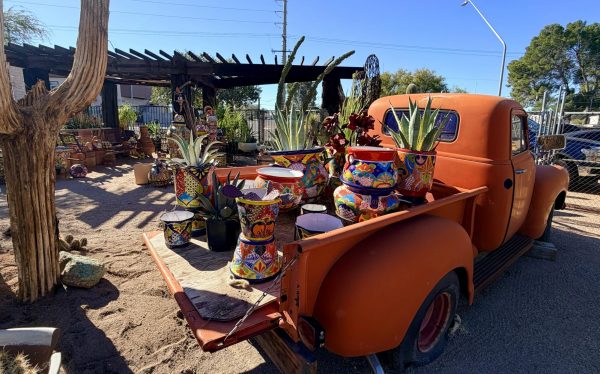
Native desert crops such as Yucca and Cactus, are on display at Ponderosa Cactus Garden, a plant nursery in Tucson, Ariz., on Feb. 26, 2026.
“Plants such as magnolias, sod grass and any plant requiring lots of water and extensive maintenance are a no-go,” she said.
You only need a few tools
Gardening does not require extensive equipment, and people may try to sell items that gardeners do not necessarily need, Carrasco said.
It is simple and comfortable, she said.
“What you need is a good pair of gloves, a long-sleeve shirt to protect your skin from the sun, a hat, closed-toe shoes, ergonomic pruners and a shovel,” she said.
Keep your small garden hydrated
Some people can handle watering by hand, while for others it’s too much during the summer months, Atkin said.
She recommends a drip irrigation system, which is adaptable for small scale gardens and helps with water conservation.
Most often, people water too frequently and not deep enough, said Jared McKinley, owner of Spadefoot Nursery, which focuses on growing native plants that support local wildlife. Shallow watering encourages salt and mineral-buildup in the root zone and shallow roots, he said.
“The buildup locks up nutrients. Aim to water less, but deeper and wider,” he said.
Another solution, Carrasco said, is to water late at night.
“Watering when the temperature is cooler or early in the morning makes it easier for your plant to absorb most of the water it needs,” she said.
Pesticides are a no-go
Companies market pesticides as a way to control garden pests, but they may not always target the pests they claim to control, McKinley said.
A pesticide-free garden is important because it supports your local ecosystem rather than poisoning healthy organisms, he said.
Pesticides may seem appealing for pest control, but they are not suitable for a desert climate, Atkin added.
“Even organic pesticides are not very effective,” Atkin said. “If you are seeing fewer pollinators in your garden, it may be a result of too much pesticide or herbicide use.”
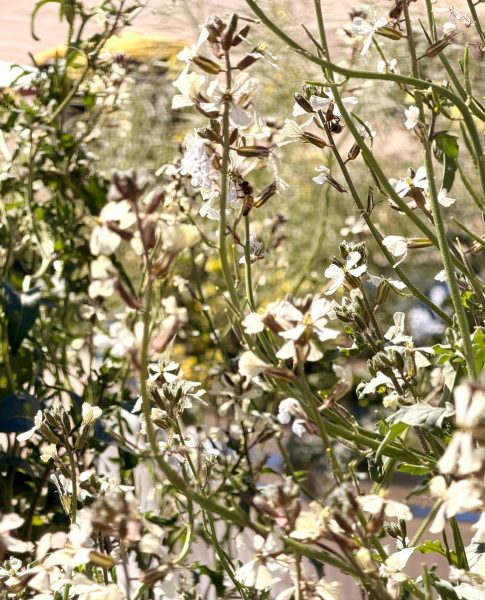
Bees suckle nectar from flowers at Tucson Village Farm an educational farm in Tucson ,Ariz., on Feb. 26, 2026.
Disrupting the ecosystem with pesticides can have lasting impacts, McKinley said.
“Poisoning troublesome organisms like mosquitoes poisons the habitat they rely on. In the long run, the poison moves up the food chain, affecting the predators that prey on them,” he said.
Get out and garden
Growing a few plants at home can be a meaningful way to spend time outdoors, Atkin said.
Gardening in a desert climate is about balance, she said, and all you need for a successful garden is water, sun, soil and love.
Local nurseries or community gardens provide resources on gardening, desert-specific crops, soil health and sustainable practices to help your garden thrive.
Arizona Sonoran News is a news service of the University of Arizona School of Journalism.