


In Tucson, students and community groups have participated in several recent demonstrations in response to federal immigration enforcement and government policy, including a Jan. 30 general strike and No Kings and ICE Out marches.
Those protests build on a longstanding history of activism in the city, including the Sanctuary Movement of the 1980s.
The movement left a legacy of activism in the Tucson community, instilling passion and unity among recent protesters, said Isabel Garcia, the co-chair of the nonprofit Coalición de Derechos Humanos.
“Our presence in the Sanctuary Movement and our fight against the border militarization has impacted the whole community, really,” Garcia said. “It’s that presence of all of us involved that has laid a groundwork for young people.”
Garcia began her activism in 1976 with the Manzo Area Council, an organization dedicated to assisting immigrants and refugees. She then worked closely with John Fife and Jim Corbett, co-founders of the Sanctuary Movement, during the 1980s and has been an active member of Tucson activism ever since.
“She’s been like a tutor because I’ve always looked up to her,” Maria Carrasco said of Garcia.
A promoter for Coalición de Derechos Humanos and Rapid Response in Tucson, Carrasco has been involved with immigration-related activism for almost 24 years. That experience has helped her build connections with activists involved with the Sanctuary Movement.
“I always remember the way they were talking and their passion,” Carrasco said.
The Sanctuary Movement
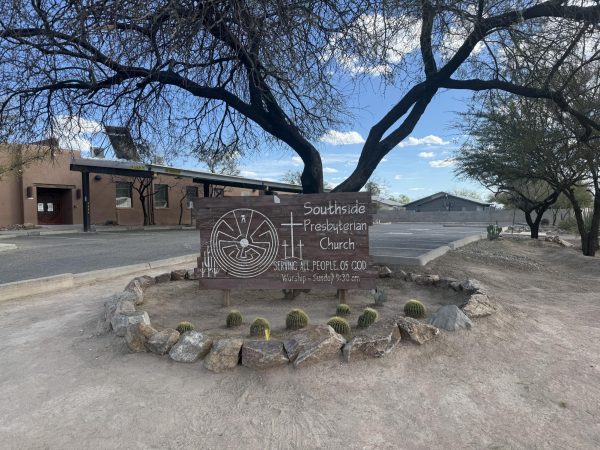
The front entrance of Southside Presbyterian Church on Feb. 11, 2026. Southside was the first church in the US to announce its status as a sanctuary for Central American immigrants on March 24, 1982.
Originating in Tucson, the Sanctuary Movement was a religious and political campaign providing a haven for refugees from Central America seeking asylum.
Southside Presbyterian was the first church in the nation to declare itself a sanctuary in 1982, creating the path for more than 200 religious orders and congregations nationwide, upwards of 600 religious organizations and several universities to declare themselves sanctuaries at the movement’s peak, according to the Sanctuary Movement trial papers in the University of Arizona Special Collections.
“Tucson has always been a community with activists,” said Bennett Burke, co-founder of an organization called Matthew 2534 in Tucson, part of the Liberal Catholic denomination.
As a minister for three decades now, Burke connects his affiliation with the church to his participation in local activism.
“My religious and political views, they’re all in agreement that we are supposed to be aiming for the higher principles of love and equality and justice for everyone,” he said.
In Tucson, that is a shared value among many, he said.
Activist Tucson today
“Everybody’s doing their little something to fight the system,” Carrasco said of Tucson’s activist community.
She highlighted those who protest despite physical challenges, such as using a wheelchair or walker.
“This is the kind of community Tucson has,” she said.
Mónica Ruiz House, the media and digital organizer for No More Deaths, said she feels a strong sense of weight and anxiety among the people of Tucson amid intensified immigration enforcement under the Trump administration.
“It’s almost palpable in the air, the fear,” she said.
Despite this fear, she is confident in Tucson’s strength and energy, she said.
“I think we are defiant. I think there’s a lot of excellent organizing going on,” she said.
A retired librarian educator, Elyse April is now involved with Justice For All and advocates for a ballot initiative that supports people in Pima County’s access to a public defender when facing deportation.
She said she is most inspired by the inclusivity she sees among today’s protesters.
“Tucson has that unique flavor of diversification,” she said. “That blending is so important to me.”
That mix includes people of different ages, and she’s noticed a mix of newcomers and seasoned activists.
It gives her hope, she said, to see “young people beginning to stand up and notice and join with these folks who did it in the 60s, the 80s.”
Burke agreed that youth involvement in Tucson activism has increased, particularly high school students showing up to protests lately.
“The high school students were great. They were loud, they were clear, they were passionate, and I’m so excited about that,” he said. “We’re seeing Tucson now coming out in all of its beautiful diversity.”