

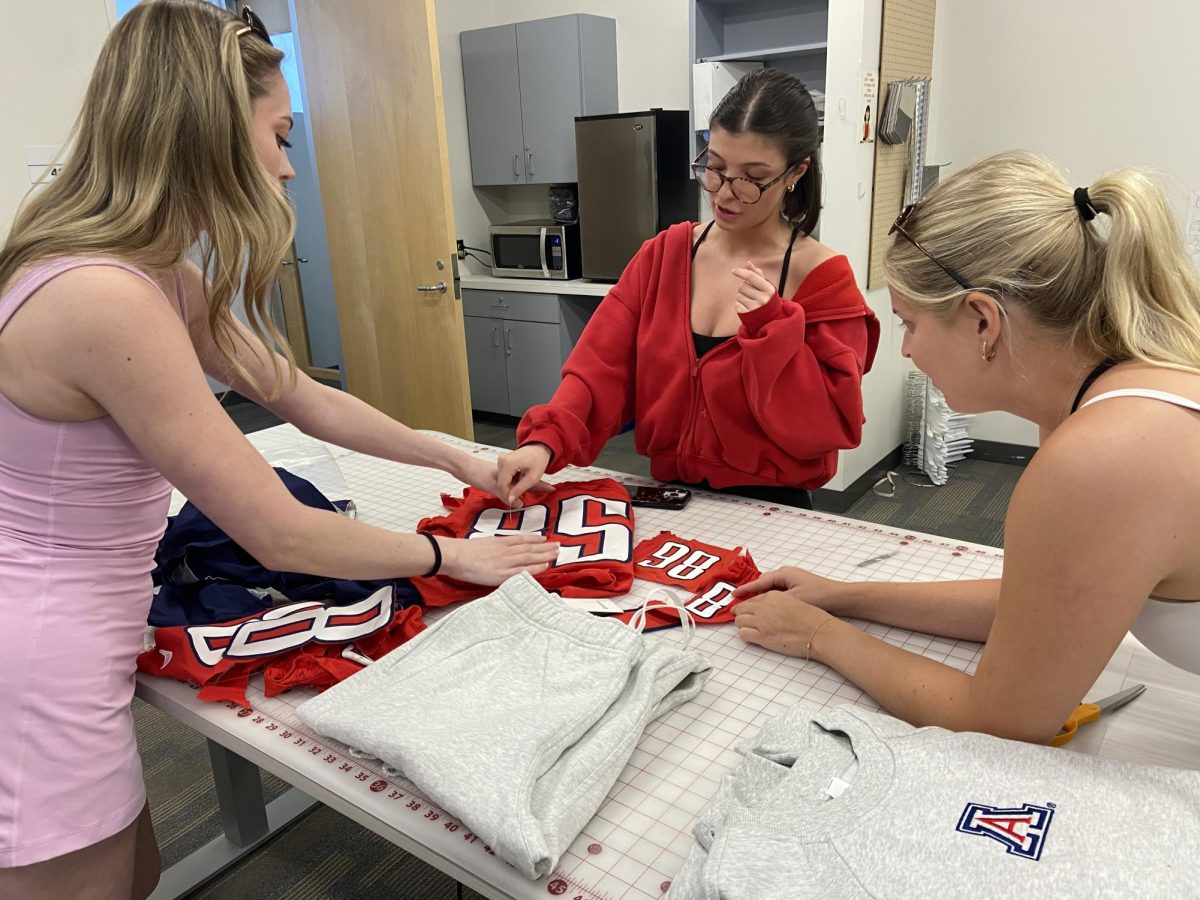
Fabric scraps scatter across tables, sewing machines whirr and University of Arizona students buzz with creativity in a studio at the Norton School of Human Ecology.
The school’s apparel production class gives students the opportunity to create clothing designs using a tangible part of the university’s history: retired Arizona sports jerseys.
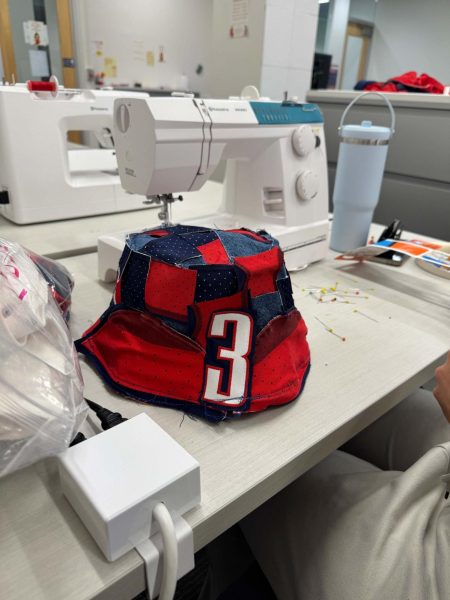
The students upcycle and repurpose the old jerseys into new garments, including jackets, shirts and hats.
“I think that’s my big thing, I hate waste,” said Elizabeth Heuisler, an assistant professor of practice at the university, who created the class in 2019.
She teaches students how to create a line of clothing and effectively market and present it to an audience. She works with the university’s marketing department to repurpose old football jerseys, incorporating a greater emphasis on upcycling and sustainability, she said.
“We are all thinking about the environment and the air quality, but we need to start thinking more about the quality of clothing and its impact,” she said. “We all wear clothes so that’s just as important, and I think students are starting to see that.”
The upcycled jerseys both keep old garments out of landfills and meet growing demand for sustainable and second-hand clothing.
At the end of the school year, student creations are sent to a manufacturer who incorporates these designs into Arizona Replay, a clothing line that sells unique, hand-made products at pop-up events at the Campus Store and other venues.
“We would take flavors of what the students were putting together, so the Replay line was inspired by student designs,” said Alixe Holcomb, associate vice president for brand development at the UA.
Origins of Arizona Replay
Arizona Replay, a collaboration between UA Marketing and the Norton School, was created in 2014 in response to student athletes’ concerns that others were profiting off their old jerseys, Holcomb said.
Student athletes are not allowed to keep their own jerseys. Instead, retired jerseys were sold at a procurement auction warehouse, oftentimes in bulk to resellers who can make hundreds of dollars selling them on eBay.
“If you had a Nick Foles jersey, if you had Rob Gronkowski, all of the sudden there was this flood of popular jerseys popping up on eBay,” Holcomb said.
Arizona Replay was born as a way to repurpose the jerseys into something wearable instead. Profits from the pop-up events are reinvested into the Norton School as well as UA Athletics, she said.
“Its first iteration was trying to solve that problem when student athletes first made the athletic department aware of it,” she said.
In 2019, Arizona Replay started partnering with Heuisler’s apparel production class to create the designs.
“Elizabeth created a senior capstone class that would help us generate ideas for the Replay program,” Holcomb said. “It became a way for us to keep the line fresh and get new ideas.”
To bring these upcycled items to market, Arizona Replay works with UA alumnus Marc Herman, who has been in the clothing business for more than 40 years. He has the university’s naming rights and is able to produce and sell a wide variety of items in limited quantities at pop-up events.
“Having an alumnus who is passionate about the University of Arizona makes it a lot better, because he was willing to put in the time, effort and energy to make sure that this program is done right,” Holcomb said.

Arizona Replay usually has at least one pop-up event each year, selling denim jackets, crop tops, bags and other items, all incorporating the retired football jerseys in limited quantities at places like the Campus Store, Levi’s La Encantada and outside of McKale Center.
The denim jackets are always the best-sellers, Herman said.
Recycling soccer jerseys
To get to that point, the old jerseys are first deconstructed and reimagined by students in the apparel production course.
This spring semester, UA Marketing sent the class soccer rather than football jerseys after renovations to the department’s storage facility.
As the first iteration of the apparel production course to work with soccer jerseys, students will create fresh designs and work with a different material.
“It will be fun to see what they come up with,” Holcomb said. “The patterns are a lot different for soccer, too.”
The class also received hundreds of Arizona-themed Lululemon sweatshirts and sweatpants that were pulled from the campus store because of a printing defect on the logo. Heuisler secured permission from Lululemon to incorporate the sweatsuits into this year’s student designs, she said.
For senior Jade Danhach, working with the jerseys has taught her the importance of detail in the clothing production process on both the business and construction sides.
“It has really emphasized that the small details do matter, with things like understanding how to source fabric,” she said.
“We get a good understanding of how companies make their products from beginning to end,” added Ainsley Wells, a senior in the apparel production class.
Construction challenges
Incorporating jerseys into designs presents a unique set of challenges, Heuisler said.
The jerseys are primarily made of polyester and nylon, presenting limitations on how they can be used, she said. The materials require students to use a different needle and special sewing techniques.
The size of football jerseys also pose obstacles when it comes to upcycling.
“These football jerseys are tiny,” Herman said. “Because they’re so tight, it makes it a lot more difficult remanufacturing them into something else.”
And upcycling and repurposing clothing is a difficult process in and of itself, he said.
“You’re cutting apart individual pieces, and because it’s used clothing, they don’t fit in one particular way,” he said. “You’ve got to have a pretty specialized person sewing these things that knows what they’re doing.”
The importance of upcycling
Despite the challenges, sustainability is at the forefront for both the apparel production class and Arizona Replay.
“The whole community wants to lessen what gets dumped and tossed into the garbage,” Herman said.
Keeping retired football jerseys out of the landfill was especially important, Heuisler said, because they are made of polyester, nylon and other plastic-based materials.
“Polyester is a big waste issue because it takes so long to degrade,” Heuisler said. “It will sit in landfills for a long, long time.”
Upcycled and secondhand clothing has become increasingly popular among Gen Z, a trend that Heuisler said she has noticed in her students.
Herman said he believes that secondhand, upcycled and vintage clothing will only increase in popularity in the coming years.
While Herman said upcycling is limited because of financial obstacles, efforts like the Arizona Replay line have the potential to create a positive environmental impact.
“Reality is, the percentage of all the stuff upcycling is really helping is to be determined,” he said. “But as time goes on, I think it may become more and more, and it’s important to keep an eye out for the future to figure out how we can make that important.”
Arizona Sonoran News is a news service of the University of Arizona School of Journalism.