

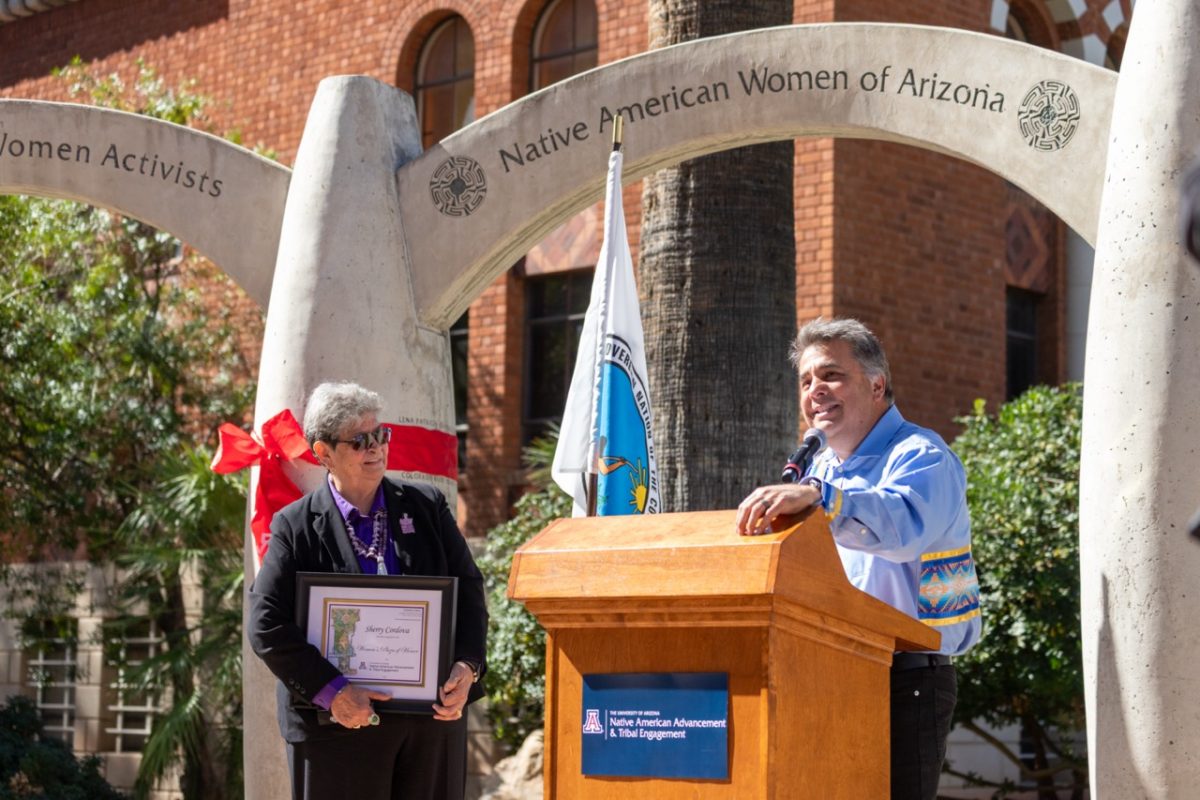
After more than four decades of leadership, Cocopah Indian Tribe Chairwoman Sherry Cordova was honored Wednesday, Feb. 18, at the University of Arizona’s Women’s Plaza of Honor, where her name was added to a permanent memorial recognizing women whose work has had lasting impact.
Cordova, one of the longest-serving elected tribal leaders in the United States, has spent more than 45 consecutive years guiding the Cocopah Tribe through major developments in tribal sovereignty, economic growth and gaming.
Wednesday’s ceremony formally inducted Cordova into the Women’s Plaza of Honor, placing her among women whose leadership and service have helped shape Arizona.
The ceremony, organized by the university’s Office of Native American Advancement and Tribal Engagement, drew students, tribal leaders and community members to the plaza, where Cordova reflected on her career and her commitment to her people.
For Levi Esquerra, special adviser to the provost for Native American Advancement and Tribal Engagement, the recognition represents more than an individual honor.
“She’s given a lifelong service to her people,” Esquerra said. “That’s an example of leadership not only for her tribe, but for all Native nations.”
Esquerra said Cordova’s influence extends beyond her tribe, with efforts to protect water rights, shape tribal gaming agreements in Arizona, and strengthen collaboration among tribes across the region.
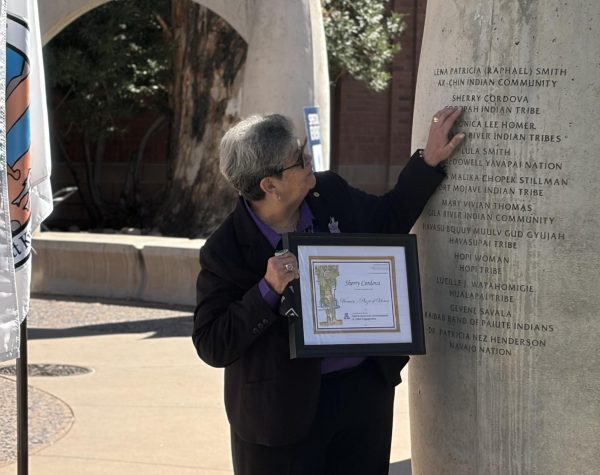
Sherry Cordova touches her name engraved on the Women’s Plaza of Honor at the University of Arizona while holding a commemorative plaque during Wednesday’s ceremony.
The Women’s Plaza of Honor, located next to Centennial Hall on the University of Arizona campus, was established in 2005 to recognize and preserve the legacies of women whose contributions have shaped Arizona and beyond, with more than 800 honorees added through a periodic nomination and selection process.
Honorees range from local leaders to nationally recognized figures, including Sandra Day O’Connor, the first woman on the U.S. Supreme Court, and Lorna E. Lockwood, the first woman in the nation to serve as a state supreme court chief justice in Arizona.
Cordova’s induction aligns with the University of Arizona’s commitment to strengthening relationships with Native nations and bringing greater visibility to Indigenous communities and leaders that impact the region. In its official land acknowledgment, the university states that it “strives to build sustainable relationships with sovereign Native Nations and Indigenous communities through education offerings, partnerships, and community service.”
For Mia Schma Miranda, a U of A student and member of the Cocopah Tribe, Wednesday’s ceremony carried personal meaning.
“There’s a lot of smaller communities that no one knows a lot about,” Miranda said.
“Recognizing them for their hard work and dedication shows they’re just as impactful as larger ones.”
Miranda said Cordova’s leadership serves as a reminder that meaningful change can come from individuals who remain committed to their communities, regardless of their age or background.
“She doesn’t consider it work,” Miranda said. “It’s just showing up for her people, her friends and her family.”
The Cocopah Indian Tribe, based along the lower Colorado River near Yuma, has a long history in the region, with deep cultural and economic ties to the land. Under Cordova’s leadership, the tribe has expanded its economic development, including gaming operations, while continuing to advocate for tribal sovereignty and resources.

Sherry Cordova, center left, poses with Cocopah tribal members and community members after being honored at the Women’s Plaza of Honor at the University of Arizona on Feb. 18.
Arizona Sonoran News is a news service of the University of Arizona School of Journalism.