


Each day, University of Arizona students make their way to class, but they do not all arrive the same way. While some drive and park nearby, others depend on campus shuttles, bicycles or walking to get to campus.
For many students without cars, bus schedules, parking costs, walking distance and heat shape their routines, budgets and energy before classes even begin.
“It definitely affects how I plan my day. If I miss the Cat Tran shuttle, I know I might be late, so I always have to think ahead,” student David Acevedo said.
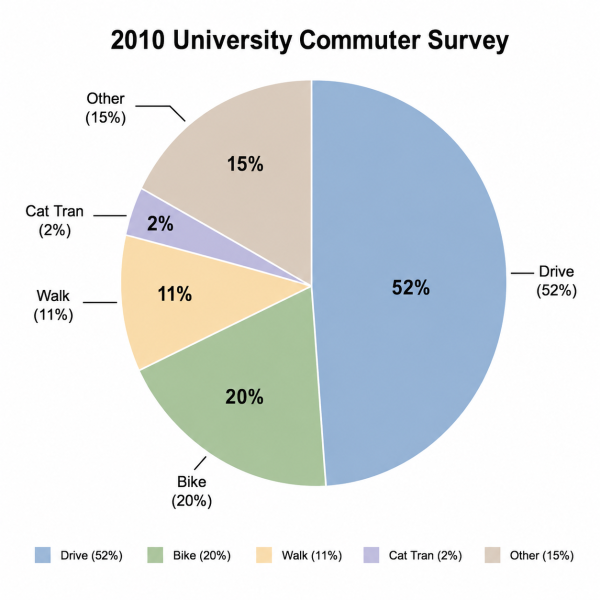
While his experience reflects a small group on campus, the most recent publicly available university commuter data, collected in 2010, suggest that driving has long been the dominant way students get to campus. That survey found that 52% of students drove themselves to campus, while 20% biked, 11% walked and just 2% used the campus shuttle Cat Tran as their primary commute method. The remaining 15% relied on other forms of transportation, including public transit, apartment shuttles and rides from others.
More recent regional figures show a similar pattern in Tucson. In 2023, about 70.7% of Tucson residents drove alone to work, while just 1% biked and about 2% walked, according to American Community Survey data compiled by the MAP Dashboard.
Students who rely on buses, bicycles or walking are among a small minority of those in the city relying on alternative modes of transportation.

Acevedo, 26, is pursuing a dual master’s degree in human language technology and data science. He starts his mornings on the shuttle.
Living near one of the shuttle stops, he takes the purple route to campus, which drops him close to the Main Library and the Modern Languages Building, where many of his classes are held.
For him, the shuttle is the most practical option.
“It’s really close to where I live,” he said. “There is like a station there and it drops me off where I need to be.”
Depending on the shuttle, however, means planning around uncertainty. Traffic, weather and delays can disrupt the schedule, turning what should be a short ride into a gamble.
Acevedo said the timing can be unpredictable and sometimes forces him to leave early to avoid being late.

“It can be hit or miss,” he said.
If he misses the shuttle, “it usually makes me arrive late to the places where I need to be,” he said.
While Acevedo waits at shuttle stops, Sara Matsumura pedals past traffic on her way to campus.
Matsumura, 27, a doctoral student in the second language acquisition and teaching program, bikes to campus almost every day after moving less than a mile away.
While she has a car, driving feels less practical, she said, especially with the cost of parking.
“I didn’t want to pay like $600 or $700 per year,” she said.
UA Parking and Transportation Services notes that annual parking permit prices vary by location and access, with some options costing several hundred dollars for the academic year.
For many students, those expenses make alternative transportation more appealing.
Matsumura’s commute now takes about five minutes along a route designated for bikes and pedestrians. Compared with walking, she finds biking faster and more comfortable, and the ride has become part of her daily routine.
“Walking makes me hot and sweaty, but biking is really fast, and I like biking,” she said.
She added that it helps her start the day feeling calm: “It makes me feel relaxed. It’s like a good form of exercise.”
She has heard about accidents around Tucson and said drivers can be unpredictable, but on campus she feels safer because of the bike lanes and racks.

There are no wheels in doctoral student Katharine West’s commute. She walks.
Living close to campus, she makes the 15-minute trip to the College of Education twice a day, four days a week. Without a car or bike, walking is simply the most accessible option and one she has come to appreciate as part of her routine.
“A 15-minute walk is a nice way to start the day,” she said.
Still, Tucson’s weather and late evening classes can make the walk less pleasant. She said the heat can be uncomfortable, and after dark, the area around her building feels isolated and quiet.
“I have class until 7:40 p.m. and so it’s dark when I get out,” she said. “There aren’t that many people on campus at the time and it can be a little unpleasant.”
Even so, the walk gives her time to think.
“It gives me a chance to kind of go through what I’ve planned for the class and to unwind,” she said.
From shuttle stops to bike lanes to sidewalks, each student’s route looks different and becomes a daily calculation of time, cost and comfort that quietly shapes how they experience university life.
Arizona Sonoran News is a news service of the University of Arizona School of Journalism.