
The man with one of the most popular websites for local culture and commentary in Hermosillo, Sonora, Benjamín Rascón, isn’t a fan of digital technology.
In fact, Rascón only recently got a smartphone.
He doesn’t want to see vacations on other people’s phones, especially if it’s someplace he’s never been. “I tell them, ‘No, no, no, put that away. Don’t show me!” he said. “The first time I see something, I want it to be the first time I see it, for real.”
Rascón thinks of smartphones and digital technology in general as the ball and chain he suffers to produce Crónica Sonora, the publication he launched as a website in 2015 and expanded to print in 2023. Crónica has survived, while most other Sonoran print publications have closed or moved to entirely online formats. The periodical amplifies the voices of unheard residents in traditionally staid Hermosillo. The outlet often features the downtrodden and the literati.
The print version became possible when Rascón was ready to reset his plans for Crónica. Now, in addition to serving a niche in Sonora’s news desert, it embodies his desire to give the community something tangible.
Rascón, 46, said he was one of the last people he knew to get a cell phone, and then only when it was thrust on him. Rascón was on his way to work with human rights observers in Oaxaca when a radio station director handed him a cell phone and a camera and asked him to document the upheaval while he was there.
Amparo Reyes Gutierrez, 40, is a historian and the department head of the Sonoran state archives. Twenty years ago, she was cleaning house when she recognized a voice on the radio. It was the curly-haired, take-me-as-I-am charmer she often bumped into at festivals and when doing research at the state archives.
“I tuned in to the radio station I listened to back then, which was a community radio station called Radio Bemba, and Benjamín broadcast a live transmission all day because he got caught in the middle of a brawl between a teachers’ union in Oaxaca and the Army. I remember listening to that entire broadcast. And thanks to that, he won the National Journalism Award,” Reyes Gutíerrez said.

Amparo Reyes Gutiérrez, director of the Sonoran State Archives stands among shelves of recent legal bulletins on Friday, Oct. 31, 2025 in Hermosillo, Mexico.
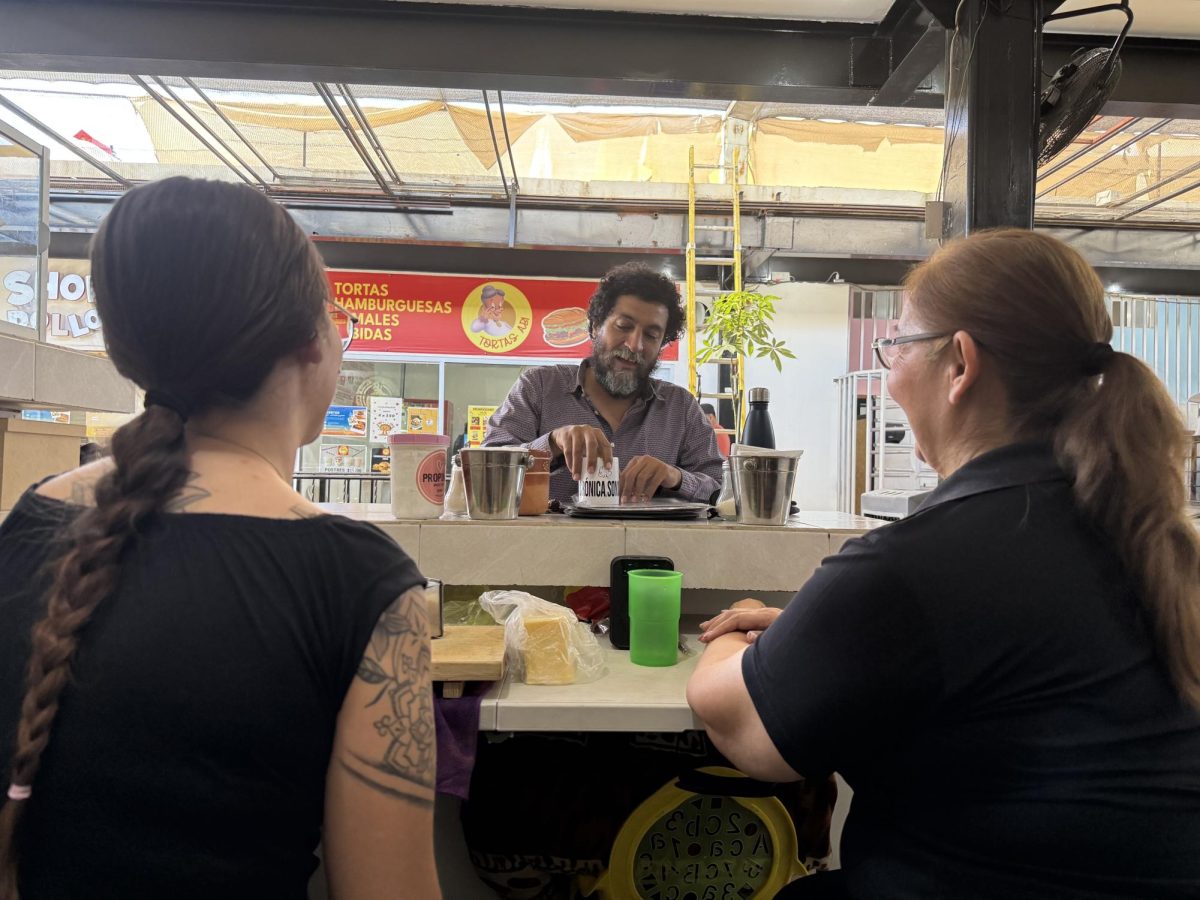
Most days now, Rascón holds office hours at the large municipal market dead center in Hermosillo’s downtown. He drinks coffee at one of the market’s many cafes and talks with everyone who shows up. When the conversation lulls, he sneaks glances at his eight-year-old daughter, Sara, in her La Catrina makeup for Day of the Dead on his camera roll.
Nearby, older men in cowboy hats and plaid western shirts, tucked neatly into jeans, held up with belts and shiny buckles, loitered and gossiped. Cigarettes dangle beneath their neatly trimmed mustaches. Phones—when there is a phone—remain fastened to the belts.
“They’re here everyday. It’s their social media,” Rascón said.
A clean-shaven man with silver-capped incisors and a puffy red face that betrayed his hangover walked through one of the open, floor-to-ceiling doorways of the market. He belted out gravelly verses of El Siquisiri.
The coffee counter crowd erupted into high-pitched cries. When the song was over, Rascón shouted, “Good day, Queraque!” assigning the busker a lyrical onomatopoeia nickname. Rascón and Queraque shook hands, hugged, and then shook hands again. Rascón doesn’t know the man’s real name, but the nickname and the prolonged, effortlessly affectionate choreography of the traditional Mexican greeting say they’re fast friends.
Rascón walked through the market, greeting everyone he passed. He recharged his phone’s data plan at one spot and bought half a kilo of cheese at another. The vendor with rounds of queso fresco the size of supermarket birthday cakes handed him a knife. “Have a taste and cut off what you want,” she said.
The municipal market energized him. It’s the town’s de facto community center and has finally opened after more than a year of renovations. Clean new tiles, bright but not unflattering lighting, and invisible infrastructure banished the darkness and dank funk that haunted the space before. “This place is almost a hundred years old. All the original plumbing beneath the market failed long ago, and a lake of sewage was forming,” Rascón said.
Rascón made a circuit through the market stands, greeted passersby and handed them printed copies of Crónica Sonora. “I know you don’t have this edition,” he said to a market regular.

Benjamín Rascón in downtown Hermosillo, where he visits the municipal market and other local businesses to promote Crónica Sonora. Thursday, Oct. 30, 2025
“He’s always been easy to recognize because of his trademark hair and beard,” said Reyes Gutierrez.
Dress him in green fatigues, plop a cigar in the middle of his free-range facial hair, and he’d win a Fidel Castro lookalike contest. If you could convince him to enter, that is. While he might share the island revolutionary’s coif and the occasional thoughts on agrarian reform, Rascón has never smoked, and the mere smell of a cigar makes him queasy enough to leave the room.
Collaborating for the love of art
Sol Fontes Real is a librarian at the University of Sonora’s Fernando Pesqueira library. She grew up in Hermosillo and, before becoming a librarian, worked as a reporter at two of the city’s newspapers, El Independiente, which ceased publication in 1998, and El Imparcial, one of the only two non-tabloid news publications still printing daily.
Fontes Real, 54, has also written for Crónica Sonora.
“You do it purely out of love for art, and it doesn’t matter. I mean, the truth is, those of us who collaborated did it wholeheartedly, because we know that if it’s going to be distributed—because he personally goes and leaves the copies in the spaces—then someone is going to read it one way or another, they’re going to read it and know that you put some of your thoughts on those pages,” she said.
Fontes Real attributed the popularity of the printed version to people’s nostalgia for something they can savor. “When Benji comes and hands you the copy of Crónica, well, imagine he’s selling you a cake,” she said. “It’s like a really delicious cake that you can still touch. And people, since they’re not used to having it anymore, have it put in their hands. And you touch it and read it because you already have it. And I think that’s very important.”
Hermosillo’s invisible heroes
Forty-nine pink and blue crosses mark a somber plot in Hermosillo’s otherwise festive main plaza, where vendors sell grilled corn-on-the-cob and parents bring their young children for photos in the gazebo. The paint is always fresh on all-caps “ABC NEVER AGAIN” in big block letters on walls all over town.
In June of 2009, a fire at the city’s ABC Daycare center killed 49 children, many of them sleeping infants, and hospitalized 40 more. Everyone in Hermosillo was permanently scarred.
Ceiling insulation prevented smoke detectors from working. Exits were inaccessible and too few. Once the fire was burning, there was no way to get to the trapped infants and toddlers.
Investigations suggested that the owners’ political connections corrupted safety oversight.
While the local media focused attention on a heroic passerby who rammed holes into the building with his pickup truck, it all but ignored the bravery of other young men—non-telegenic drug addicts and cholos—who entered the burning daycare afterward to rescue children.
In an early article in Crónica Sonora, Rascón profiled the slighted heroes in an effort to remedy that myopia. It also defined the publication as one that told everyone’s story.
Fast-forward five years to the end of 2021. The Crónica Sonora website featured scores of original articles and images on culture and politics in Hermosillo. Still, in the eye of the pandemic, Rascón was going stir crazy. He was especially frustrated that what he’d conjured to be a real paper, smelling of ink and newsprint, was still just bright blue light sealed in glass rectangles that made his eyes and head hurt.
Rascón was ready to stop. He said, “I was fed up, angry. I no longer wanted Crónica Sonora to be just a digital publication. I was tired of editing for the screen, on and for the screen.”
He explained that if it weren’t for the print version, he’s not certain Crónica would still exist. Rascón attributed the print version’s existence to a chance meeting with Jeffrey Banister, the director of the Southwest Center at the time.
Banister, 57, now a research scientist and associate professor at the University of Arizona, said that the Center did provide some financial support, but Rascón’s moxie was mainly responsible for the print quarterly’s tenure.
“It’s not easy to run an independent, periodical, in northern Mexico. I mean, it’s not easy anywhere. But it’s definitely not easy there, and he’s worked his ass off to do that,” Banister said. “And he’s got a very kind of magnetic personality and just does a good job of connecting people and getting their stories and making people feel at ease.”
Rascón drifted from the market, up the street to Cafeteria Mary in an open-air plaza. Another customer arrived. Rascón slapped him on the back. “Give these women some peace!” the man said. The men shake hands, hug, and shake hands again. While the man ordered, Rascón glanced at the photo of Sara before he set his phone face down on the counter in front of him, next to a sweaty mug of creamy iced coffee that smells dark and sweet with cinnamon.
Hours later, Rascón’s office moved to a cooler, quieter restaurant where he thought there would be fewer interruptions. But, by choice, Rascón is never really free from them. He handed a copy of Crónica to a woman mopping the floor, then to a waitress and a busboy. Their faces lit up like kids getting gifts from a visiting uncle. Soon, another busboy appeared with the pretense of mopping the already mopped floor. Rascón held out a mutant poker hand of four editions. “Do I want one?” the young man said, trying to sound uninterested. “Sure, I guess.” He selected the music issue, the one with Peso Pluma on the cover. His jaws relaxed, his eyes smiled, and he left the room, forgetting about the redundant cleaning job.
Also, there were more old colleagues in the next dining room, and at the end of his workday, Rascón stopped and talked them into posing for selfies with him and copies of Crónica Sonora.
“Everybody knows Benji,” Fontes Real said.
On Saturdays, Rascón likes to go to Kino Bay with his wife, Santa Lopez, and Sara. They find parking and lunch on a narrow street in the old fishing village near where a pier fell into the bay during a storm a few years back. They turn off their phones and watch the rest of the weekend happen to them.
“I like the surprise,” Rascón said.
Arizona Sonoran News is a news service of the University of Arizona School of Journalism.