

 First things first, let’s get this out of the way — college athletics is big business.
Sure, the phrase “student athlete” sounds great, but for college basketball, and especially college football, the bottom line is as big of a factor as anything happening on the hardwood.
During the 2013 March Madness tournament – where Louisville managed its way through the field to beat Michigan in a memorable championship game – advertisers spent more than $1.0 billion on advertising, according to Kantar Media. That total topped even the super bowl, which logged-in at a mere $976.3 million.
This exchange of cash is why CBS and Turner Broadcasting shelled out more than $740 million for rights to cover the games; it’s why ESPN invested $5.64 billion over 12 years to broadcast the coming college football playoffs; and it’s why the Pac-12 Network came to a $3.0 billion deal with Fox and ESPN in 2012.
The money is there in college athletics. And, it’s why every year Ryan Brewer, an assistant professor of finance at Indiana University-Purdue University Columbus, comes out with a list every basketball and football season ranking the value of big time programs if they were bought and sold like professional franchises.
“If you want to do good, solid decision-making, thinking about a university like a business is the [right] idea,” Brewer said.
While not every basketball program is profitable, and in those cases a business decision must be made to see if it’s worth spending money there versus academics, Brewer said that schools that spend around $70 or $80 million typically hit a “magic spot” and brings in a positive cash flow.
So for universities like Louisville or Arizona, it’s not a worry about losing money. It’s about how much can they make.
And, according to Brewer’s calculations, the improving financial market has the values of big time athletic programs on the rise. The top five program increased by 68.8 percent in value from the year prior, mainly from the improving strength of college basketball’s peer program (the NBA) and the “more vigilant” efforts to monitor legal issues, like the Jerry Sandusky scandal.
Two colleges — Arizona and North Carolina — moved up in the top five, but Louisville still reigns supreme. After
|
By the number: Team (Conference) Value (in millions)
Source: Wall Street Journal; Ryan Brewer IUPUC |
winning the most coveted award in Brewers rankings, the Cardinals got a nice, little National Championship trophy for its efforts
The Wildcats weren’t far behind, being evaluated at $224.1 million if sold on the market, and UA Athletic Director Greg Byrne said it’s a great reflection of both the university and the program.
“That is a great reflection on our university great reflection on our basketball program,” Byrne said. “Great reflection on the job our coaches are doing, coach [Sean] Miller in particular, and our fans to support in the manner they do.”
Compensating for other areas
As impressive as it is for the UA, Louisville and the other programs valued in the top six, all six basketball powerhouses have one thing in common — quite frankly, they stink at football.
While it’s not the case every year, and Louisville’s 11-2 record and Sugar Bowl victory last season would beg to differ, none of the top basketball schools have a traditionally strong football program.
The top six teams (UL, Kansas, UNC, UA, Indiana and Kentucky) combined to go 34-40 in 2012. Spread over a three-year span, the winning percentage drops to an even lower .433 percent. The national stage hasn’t been any better, either, as none have won an outright national title, though Kentucky came close in 1950.
Compared to basketball, where they’ve won a combined 25 national titles, these schools are lopsided, to put it kindly.
Since football is the real revenue generate, the universities might have picked the wrong sport. But, as Brewer pointed out, basketball success is much better than no success.
“If you don’t have a strong football program I think it’s clear that having a strong basketball program does a lot for your recognizability and marketability for your school, there’s no question about that,” Brewer said. “Having some is infinitely better than having none.”
 In a perfect world, schools would want to be like No. 7 Ohio State (who finished No. 5 in Brewer’s football rankings), especially since the two sports play at mostly separate times of the year. Any exposure is big, though, and the NCAA Tournament’s newest Cinderella, Florida Gulf Coast, will discover that quickly.
The small school of less than 12,000 in Fort Meyers was relatively unknown before making its improbable Sweet 16 run as a No. 15 seed. Now that people know the “Dunk City” Eagles spend their days studying at dorms on the beach, FGCU will likely see a huge financial bump like that of previous tournament sweethearts.
When George Mason inexplicably made the Final Four in 2006, it netted an estimated $677.5 million from media exposure, according to a report by GMU associate professor Robert Baker. Equally as impressive, GMU saw a 350 percent increase in admissions inquires and a 40 percent increase in out-of-state applications.
Florida Gulf Coast is nowhere near the level of the top-tier schools, and its loss of head coach Andy Enfield to USC will most likely hurt the program in both the short and long term. But, no matter what the future holds for the Eagles on the court, the university was given a huge boost off it.
“If you don’t have a good football program, if you’re not on TV all the time in football,” Brewer said, “having a basketball program like Duke is big for the school; it really is.”
Bearing down means money pouring in
Arizona also it to the Sweet 16, but unlike FGCU, the Wildcats’ basketball program doesn’t need any extra money to survive. Its baseball, softball and soccer teams do, though.
Even with the UA baseball team winning the College World Series, Byrne said the team didn’t make any money. In fact it had a net loss, and that’s after a season where the Wildcats saw a 189 percent increase in total attendance from the year before and additional revenue from beer sales.
“Our basketball program is a critical component of our ability to have a top notch athletic program,” Byrne said. “We’re adding sand volleyball so out of 20 of our sports, 18 of them lose money. So we need to be strong at men’s basketball to support the other programs that we have.”
So even with the fourth most valuable program, Byrne said the athletic department isn’t sitting back. The university is planning some renovations to the iconic McKale Center, which just celebrated its 40th anniversary.
What makes Arizona, and the rest of the top teams, so valuable is its fan support, in addition to the on-court success.
Brewer’s formula takes two separate measures and combines them to capture a whole picture of the program. In addition to looking at operating income and cash flows, Brewer also looks at the size of the school (in terms of enrollment) and the stability of the sustain performance to help calculate risk.
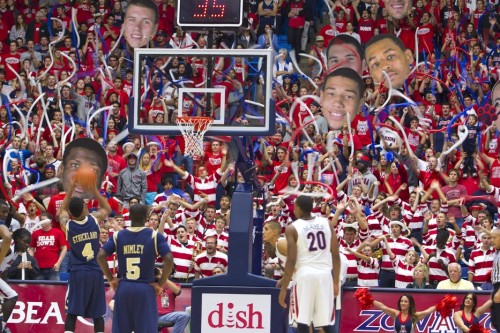
Arizona isn’t a perfect school; and its football fandom is flaky at best. But, the passion of the Wildcat basketball fans, both students and alumni, has Arizona as one of the most valuable programs in the country.
“You tell 14,500 to wear white and about 14,400 of them wear white,” Byrne said.
“People have passion for it.”