

In July 2025, a Consumer Affairs study ranked Tucson the fifth most dangerous city for cyclists in the U.S. Earlier this year, the City of Tucson took a step toward improved safety in an unlikely spot: a public park.
The city’s Department of Transportation and Mobility held a public meeting at Mitchell Park in February to discuss plans for a protected bike lane on Mountain Avenue. It was the latest in a series of meetings set up by the department to discuss road safety improvements funded by Tucson Proposition 411, which was approved by voters in May 2022.
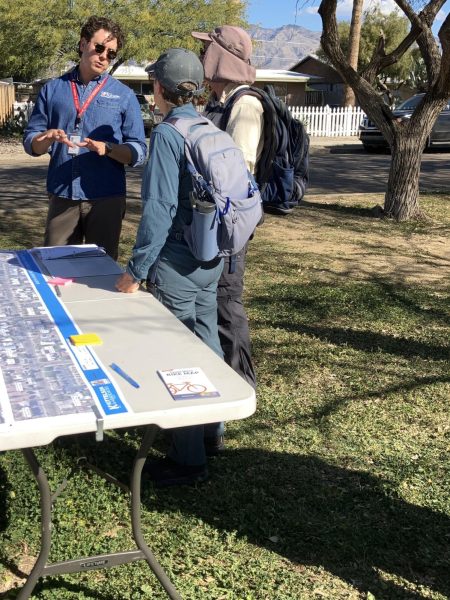
Ben Elias, a project manager at the Tucson Department of Transportation and Mobility, talks to two cyclists behind a table showing a conceptual map of the proposed Mountain Avenue protected bike lane at the public meeting at Mitchell Park in Tucson, Ariz. on Feb. 7, 2026. The meeting ran from
Mountain Avenue already has a bike lane, but this project would extend and improve it, with construction planned from Speedway Boulevard to Fort Lowell Road.
“We’re adding pre-cast concrete curb, flexible bollards and flexible delineator posts to protect the bike lane from the vehicle lane,” said Ben Elias, a project manager at the transportation department.
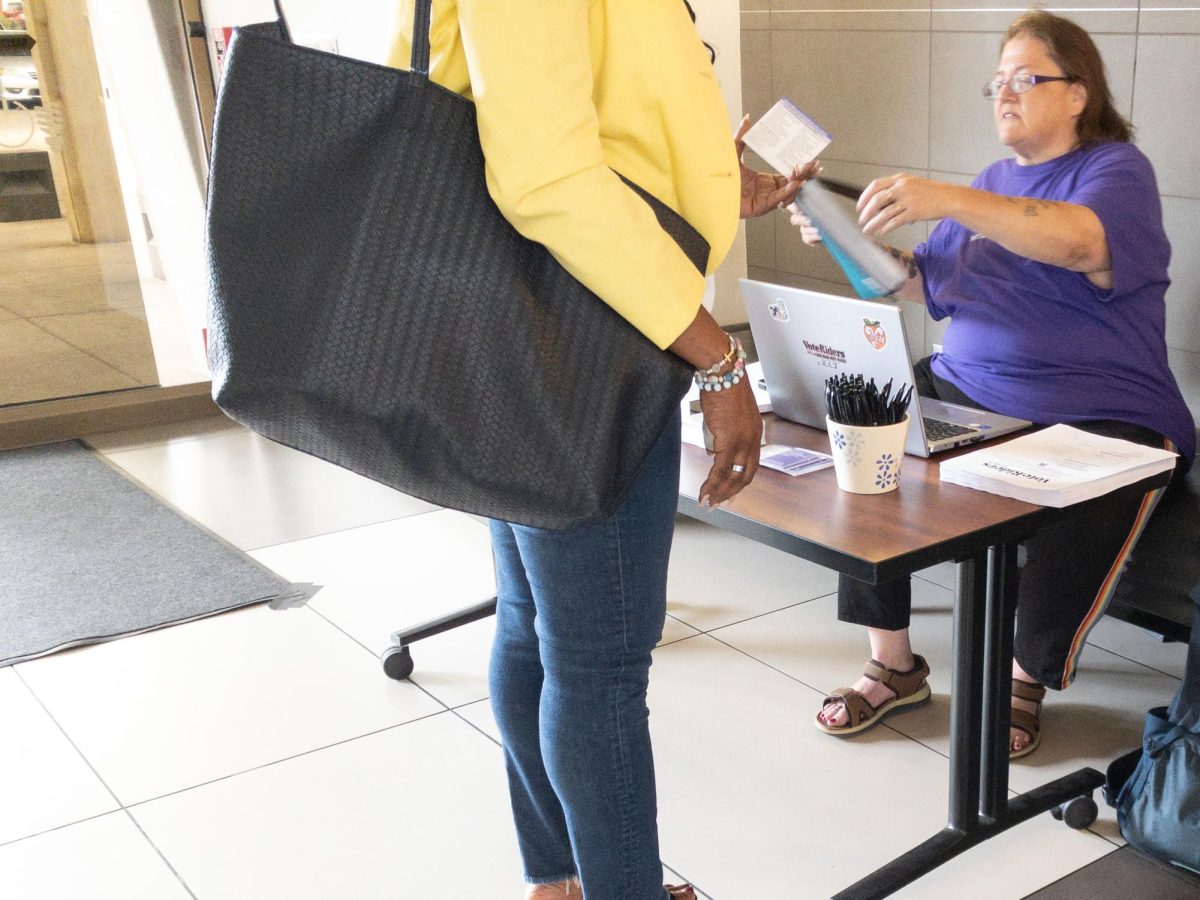
As the meeting began, officials set up paper slides on stands. At a plastic table that served as a welcome desk, Clarisa Quezada offered pastries and coffee from the popular La Estrella Bakery. The desk also held flyers, bumper stickers and brochures relating to the planned construction of the lane. Another table displayed a conceptual map showing what the planned lanes may look like in the future.
Throughout the 90-minute meeting, a few dozen cyclists arrived at the park, where they talked to officials and took advantage of free bike repairs courtesy of RC Bicycles, a local bike shop owned by Ryan and Lisa Wirtz.
“I think it just promotes biking as an alternative form of transportation,” Lisa Wirtz said of the planned overhaul. “I think it’s a hundred percent positive.”
But not everyone was as enthusiastic.
Denise Meeks, a cyclist and retired Pima Community College professor, expressed concern about the state of Mountain Avenue. Cars enter the bike lane on Mountain to avoid the many potholes, she said.
“So now they’re going to put the bike lane in, but we’re still going to have people who are going to be trying to use the bike lane,” she said. “This doesn’t fix the problem.”
Meeks has long taken issue with the city’s handling of bicycle infrastructure, which she feels has been too slow. While she has never felt safe biking in Tucson, she believes it has gotten worse over the last few years, adding that she doesn’t trust the city to continue prioritizing cyclists in the future.
A Consumer Affairs study based on National Highway Traffic Safety Administration data found that Tucson had 1.47 cyclist deaths for every 100,000 residents, more than four times the national average. According to the study, car crashes killed 147 people in Tucson in 2023, including eight cyclists.
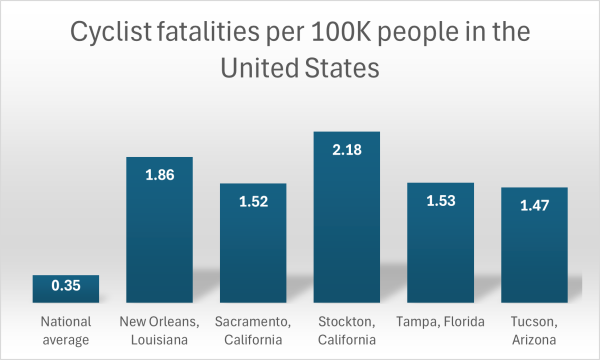
A chart comparing the cyclist fatalities per 100K people in the United States between the five most dangerous states for cyclists. Data courtesy of Consumer Affairs.
Even so, Elias said the community response to the Mountain Avenue project has been mostly positive.
“The feedback that we get from folks is that of course there’s always room for improvement, but they’re very excited for the improvements and are continually asking for more of them,” he said.
He acknowledged that the state of Mountain Avenue’s asphalt was “pretty rough,” but said that the department can’t repave the road because the program’s money comes out of a dedicated safety budget.

A cyclist crosses an intersection with protected bike lanes and cracked asphalt between Helen Street and Mountain Avenue in Tucson, Ariz. on Feb. 9, 2026. The City of Tucson plans to extend the protected lanes across the avenue, starting from its intersection with Speedway Boulevard and reaching the intersection with Fort Lowell Road, but some have expressed concern about the condition of the asphalt.
“We’re going to do our best with our street maintenance team to repair any potholes and major issues in the roadway so that everybody is a little bit safer traveling along Mountain,” he added.
For Wirtz, those efforts are a step in the right direction.
She said she feels safe biking in Tucson, but admitted that cyclist safety hasn’t necessarily improved in recent years.
“I think they’re working on it,” she said.
As of April 1, additional community meetings about bicycle infrastructure are on hold while the Department of Transportation and Mobility attempts to secure additional funding for the repaving of roads, Elias said.
Arizona Sonoran News is a news service of the University of Arizona School of Journalism.