

During Oktoberfest only two things are certain – beer and polka.
As guests enjoy sips from local breweries, their ears are treated to energetic folk music that encourages participants to hit the dance floor.
In Tucson, local accordionist Peter Kron brings the “oompah oompah.” Kron, 64, is a frequent sighting around Tucson Oktoberfests where he focuses on spreading “Gemütlichkeit” or the spirit of good fellowship.
“That’s what I enjoy most,” Kron said, “connecting with the audiences and seeing them come up to dance.”
Kron has played accordion since he was 10 years old, after his father encouraged him to take up the instrument. Kron’s father performed in Germany, but his time as an entertainer was cut short after someone stole his only accordion. Not having the money to buy a new one, his performances stopped, but he wanted his son to become an accordionist in his place.
Fifty years later, Kron performs like his father once did, with his own accordion and lederhosen, to spread German culture and good cheer across Southern Arizona.
German Oktoberfests ran from Sept. 20 until Oct. 5, but in Tucson, celebrations can continue into early November. Tucson businesses, including Casino del Sol, Trail Dust Town and the Mercado District host their own Oktoberfests. So does the German-American Club of Tucson. Those celebrations give local accordion players, like Peter Kron and the Accordion Club of Tucson, a chance to showcase an instrument rich in history and culture, while giving Tucsonans the chance to hop-step along with traditional polka tunes.
The ins and outs
Accordions are heavily suited for one-man-band performers, like Kron, because accordionist can play multiple notes simultaneously. On a piano accordion, while the push and pull of the bellows creates the sound, the right hand is traditionally used for the melody while the left hand plays the accompaniment. This gives the accordion a rich and full sound even when played solo and allows the accordionist to lead the sound while playing in a band.
“It’s a lot of work. The accordionist is traditionally the first in and last out,” Kron said. “I joke that in my next life I’d rather be a trumpet player.”
The diverse sounds of the accordion also allow the instrument to play a wide variety of styles, including folk, Latin and rock. While Kron focuses on polka music, Steve Yool prefers to play classical and jazz.
Yool, 78, was one of the founding members of the Accordion Club of Tucson. Starting in 1998, led by Jim O’Brien, the group has brought together Tucson’s accordionists every second Sunday of the month for group tunes and solo performances.
“It’s the ultimate Y2K instrument,” Yool said, citing the accordion’s versatility and similarity to other instruments like the piano.
Before retiring in 2016, Yool taught geography at the University of Arizona. He combined his love of the accordion and geography by performing at assemblies in local schools. These performances included music from across the globe, helping students connect countries with culture.
Although he no longer offers them, Yool also taught accordion lessons. He explained that music is an important part of brain development as it helps create and maintain neural pathways. This is where the accordion shines as the different functions of the left and right hand activate more parts of the brain.
“You play music to stay young,” he said.

Accordionists push and pull their instrument to make different sounds as the wind blows in and out of the reed block (pictured above), similarly to the harmonica. Digital accordions are often reedless and instead make sounds via a digital interface, but some accordions can be digital-acoustic hybrids.
Accordion to history …
The exact history of the accordion is still debated among historians, but it may have gotten its roots in Berlin in 1822. The accordion proceeded to dominate the classical and folk music scenes across Europe, becoming a musical staple within countries like Germany, Poland and the Czech Republic. European immigrants later introduced the accordion to North and South America, where it also began to take hold within folk settings.
In the United States, the instrument was adapted into Cajun and Tex-Mex music and immigrants from across the globe continued to bring with them their own unique folk styles.
The 1950s is often referred to as the “golden age of the accordion” in the United States, thanks to its presence in pop culture, greater household disposable income and door-to-door solicitation.
Accordion studios in major cities sent salesmen to canvas local neighborhoods, offering rental instruments and free lessons. During his childhood, Yool’s family was visited by one such salesman who offered him a music test.
“They told my parents, ‘Your son is a musical genius’,” Yool said.
It was that visit that started his journey as an accordionist. Even 70 years later, Yool owns two accordions, named “Joe” and “Tony,” and plans to continue playing.
It’s believed that, following the introduction of electric guitar, the accordion’s popularity slowly quieted down. However, squeezeboxes remain popular among folk musicians and pop artists like “Weird Al” Yankovic, who parodies trending songs into polka styles.
While Tucson might not be the accordion capital of the United States, the accordion perfectly showcases the city’s multicultural history, highlighted in events like the Tucson Meet Yourself. Local bands like the Bouncing Czechs, the Celtic Out of Kilters and the Tohono O’odham’s Gertie and the T.O. Boyz all feature an accordionist playing blends of unique cultural folk music for Tucsonans to enjoy.
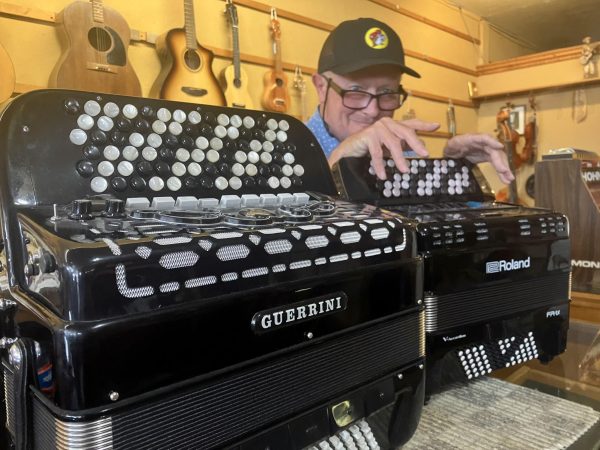
Evan Dain showcases his accordions in The Folk Shop on Oct. 10, in Tucson, Arizona. Accordions come in two main styles, button (pictured above) and piano (not pictured). Piano accordions are commonly favored by pianists thanks to their familiarity, but the versatility of the button accordion is sometimes favored by other musicians, like Dain, who professionally plays several string instruments.
Squeezed out
Over the years, many accordionists have seen waning interest in the instrument as it slowly loses steam.
Kron noticed how events like Oktoberfest, which traditionally overflow with German culture and folk music, have shifted to meet the demands of modern attendees.
“It’s not the traditional oompah oompah of yesterday,” Kron said.
He noticed that recent event goers preferred traditional American tunes and changed his repertoire accordingly. While Kron still plays classic polka songs, the songs that receive the most engagement include Elvis’ “Can’t Help Falling in Love” or Neil Diamond’s “Sweet Caroline.”
“You didn’t hear that before,” he said.
Kron is also a member of the Tucson Accordion Club, along with Yool, but they, too, have been facing declining interest. The group, which traditionally doesn’t allow younger members, has been battling attrition as members move or pass away.
“We used to have over 30 members,” said Yool, who has been encouraging the group to allow youth membership. “Now I can count the number of members on my fingers.”
Despite its diminishing popularity, some beginner accordionists in Tucson are still committed to learning the instrument, like Evan Dain, who works as an accordion technician at The Folk Shop on North Campbell Avenue.
Dain was fascinated by the instrument ever since its depiction in the 1955 Walt Disney animated film “Lady and the Tramp.” He started taking lessons last year to learn how the instrument works before he started repairing them.
“To fix an instrument you need to know how it sounds,” he said.
Since The Folk Shop started advertising accordion repairs, Dain has seen a lot more accordion players come to the shop, with some even traveling from Phoenix or other parts of the state. He fixes a lot of accordions that have been sitting in closets for decades until their owner finally decides to pick them up again. Some children also come to The Folk Shop, when their parents are buying them their first accordion, bringing the squeezebox into a new generation.
Arizona Sonoran News is a news service of the University of Arizona School of Journalism.